


A dream about an old friend, a partner or someone you have never met can stay with you long after waking. You may feel comfort, longing, surprise or unease. Start with what you remember before deciding what it means.
Dreams can draw on experiences and emotions, yet their exact purpose remains uncertain. The National Institute of Neurological Disorders and Stroke’s sleep guide notes that events from the day can enter dreams and that dreaming may help process emotions. That does not give each person in a dream a fixed meaning.
Who appeared, and what do they mean to you?
Use these possibilities as prompts. Your own association may differ, and you do not need to choose an explanation.
1. An ex-partner
What does that relationship bring to mind now: a memory, a need, a difficult lesson or a stage of life? The dream does not establish that your ex wants contact.
2. A current partner or crush
Notice your hopes and concerns, then separate them from what the person has actually said. Dreaming of closeness does not establish mutual interest.
3. An old friend or classmate
Ask what you associate with that time in your life. A recent place, conversation or song may also have reminded you of them.
4. Someone you see every day
A colleague, neighbor or family member may be familiar material for a dream. Ask which moment or feeling stood out rather than assuming a hidden message.
5. A stranger
Focus on the role, behavior or emotion you remember. An unfamiliar person does not prove a destined meeting or a secret connection.
6. A public figure
Reflect on the qualities you associate with their public image. The dream does not reveal private information about them.
7. Someone who has died
You may find comfort in the experience or understand it through your spiritual beliefs. Missing the person and remembering them can also be part of your reflection.
8. Someone in danger or dying
A frightening scene does not predict their death. Give yourself time to settle, then consider your feelings without turning the dream into an alarm about the person.
Does it mean they are thinking about you?
A dream does not provide evidence of another person’s thoughts, feelings or whereabouts. You may believe in dream visitation or telepathic connection, but the vividness of a single experience cannot establish that explanation.
Keep the distinction gentle and clear: “I felt close to them in my dream” describes your experience. “They sent this because they want me back” adds a claim about them. The first can be meaningful without requiring the second.

Look at the feeling and the recent context
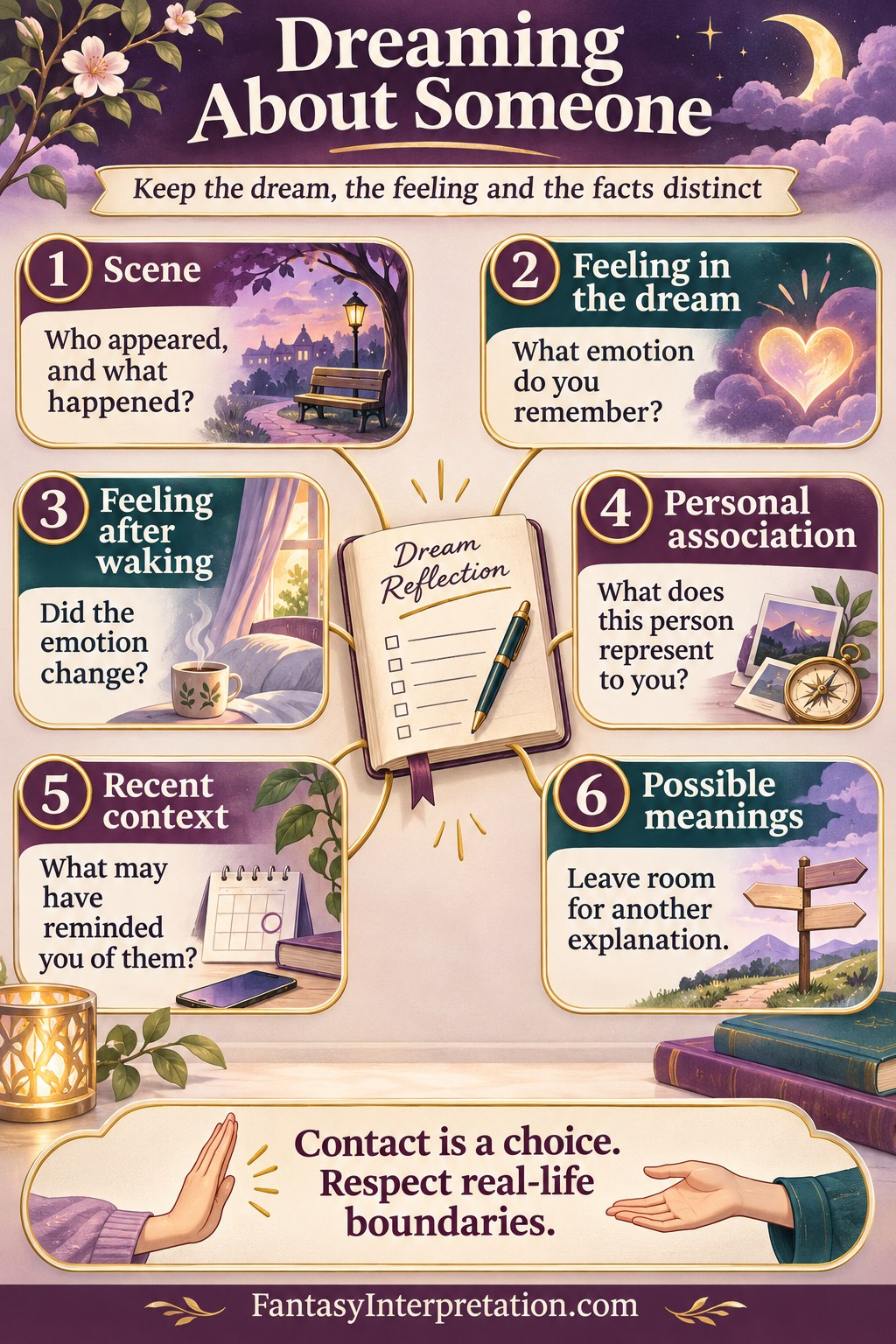
Notice whether the main feeling was affection, embarrassment, anger, safety or loss. Then ask whether a current situation evokes something similar. An argument in a dream might lead you to reflect on an unresolved concern, but it does not prove that the person is angry with you.
Cleveland Clinic’s explanation of dream meaning emphasizes the subjective nature of interpretation. Two people can dream about a similar scene and attach different meanings to it.
If intimacy was part of the dream, our sex-dream theme guide offers nonjudgmental prompts without assigning desires or identities from a dream.
If you want to reach out
Choose on the basis of your actual relationship, not because you feel the dream obliges you. If contact is welcome, a simple message can be enough. You do not need to tell someone a dream proves they miss you or need help.
If they have asked for no contact, respect that boundary. You can honor the feeling privately through a memory, a prayer, a drawing or time with someone supportive.
Recurring dreams and unsettled sleep
You can keep a brief record of recurring themes without spending the day checking for signs. It is also fine to stop journaling if it increases your distress. A dream is not a task you must solve before you can move on.
The NHS nightmare guidance recommends seeking medical advice when regular nightmares affect sleep and everyday life. Support can address the distress even if the dream’s meaning remains uncertain. If you woke unable to move, see our sleep-paralysis and nightmare guide for the distinction.
Frequently asked questions
1. Why did someone appear in my dream?
There may be several possibilities, including memories, recent experiences and personal associations. A dream does not come with a fixed explanation.
2. Does dreaming of someone mean they miss me?
No. The dream does not establish what the person feels. Consider their actual words and behavior separately.
3. Does it mean they are thinking of me?
A dream alone is not evidence of another person's thoughts or a telepathic message.
4. Why dream about someone I have not seen in years?
Consider what you associate with that person or period of life and whether something recently reminded you of them. You may also find no clear connection.
5. Does dreaming about an ex mean I should return?
No. A dream does not decide whether a relationship fits or whether contact is welcome. Consider the present circumstances.
6. Can I dream about someone without wanting them romantically?
Yes. Dreaming about a person does not by itself establish romantic or sexual attraction.
7. What if the person is a stranger?
Explore the feeling or role you remember without assuming the stranger is a destined partner or a real person sending a message.
8. Can a dream about death predict a death?
A frightening dream does not establish a future death. Care for the distress without treating the scene as a forecast.
9. What about a dream of someone who has died?
You may experience comfort, grief or spiritual meaning. You can value the experience while leaving its cause uncertain.
10. Does an argument mean the person is angry with me?
No. The dream does not show their current feelings. If there is a real concern and conversation is safe, discuss what actually happened while awake.
11. Should I contact someone after a dream?
Only if contact is welcome and appropriate in your actual relationship. A dream does not override a request for no contact.
12. How do I use a dream journal?
Record a few details, feelings and personal associations. Separate the dream from facts and keep the record private.
13. What if I cannot remember the whole dream?
Work only with what you recall and label gaps as unknown. You do not need to fill them with guesses.
14. Do recurring dreams require interpretation?
No. You may reflect on them, but you do not have to solve them. Seek support if nightmares affect sleep or daily life.
15. Can I explore a spiritual meaning?
Yes. Keep the meaning personal and consider more than one explanation without making claims about someone else's private life.