


An intimate dream can feel surprising, especially when it involves someone you would not choose in waking life. You can explore it with curiosity without treating it as a confession, a prediction or an instruction.
There is no fixed translation that makes every sex dream mean the same thing. Your feelings, associations and recent life may offer more useful starting points than a dictionary’s verdict. Cleveland Clinic’s discussion of dream meaning explains that specific dream content does not have a consistently proven interpretation.
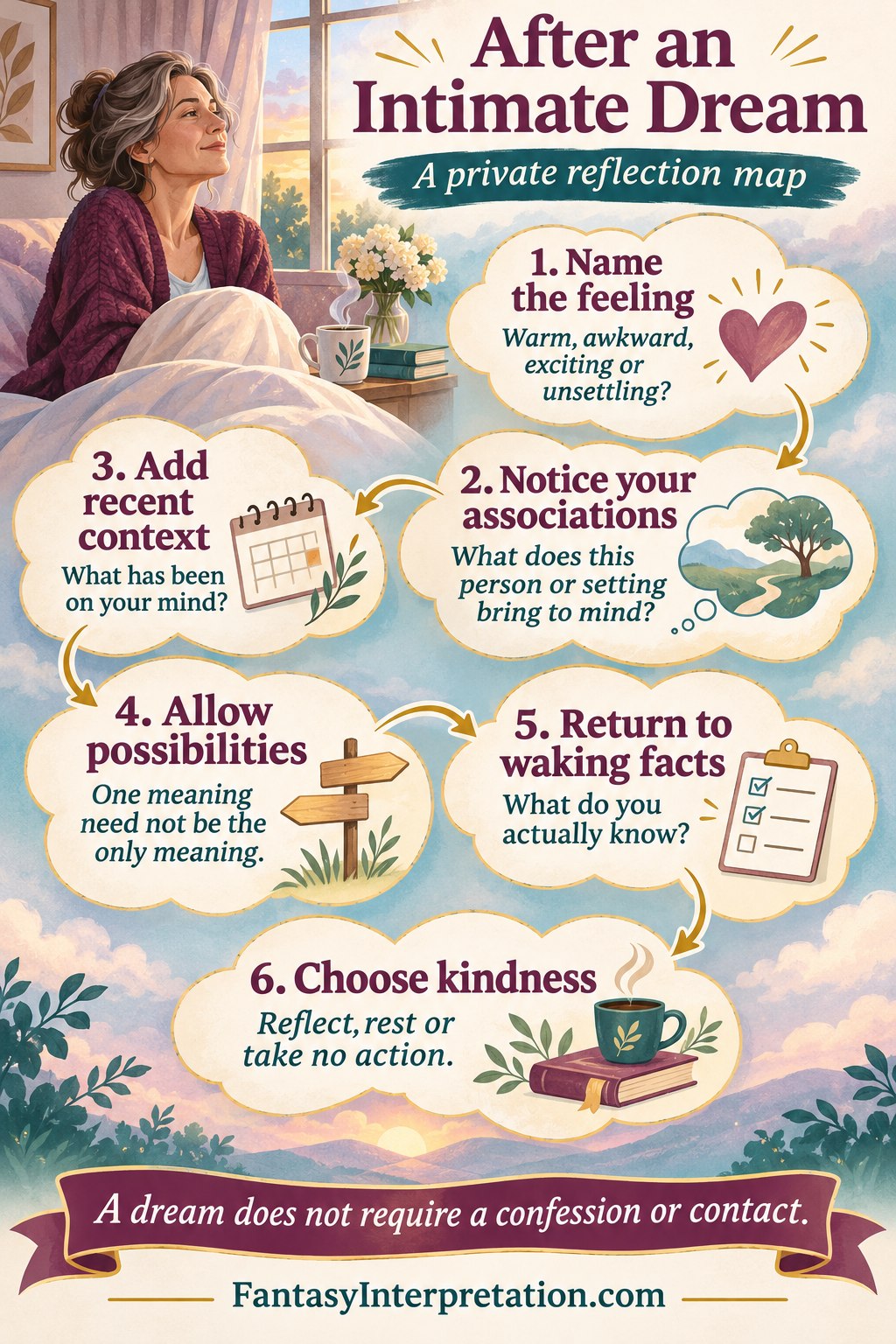
Begin with the feeling, then the story
Was the dream warm, awkward, exciting, frightening or confusing? Did you feel that way during the dream, after waking, or both? These can be different experiences. You do not need to describe explicit details to reflect on the emotion.
The ten themes below are invitations to ask questions, not established meanings or a ranking of the most frequent dreams.
1. An ex-partner
You might notice a memory, an unfinished feeling or a contrast with your life now. Ask what that period represents to you. The dream does not show that your ex wants to return.
2. A boss or authority figure
Consider what you associate with the person: approval, pressure, confidence or responsibility. You may find a useful connection, or none. A dream alone does not establish waking attraction.
3. A stranger
Ask which quality or feeling stood out rather than trying to identify a destined person. An unfamiliar face does not prove that you will meet someone or that a stranger is spiritually pursuing you.
4. A friend
Reflect on familiarity, closeness or admiration. If you also notice attraction while awake, consider it separately. The dream does not tell you what your friend feels or require a conversation.
5. Cheating
Notice whether guilt, insecurity, novelty or a broken agreement felt central. A dream is not evidence that either partner has been unfaithful. Discuss actual concerns through observed behavior.
6. Power or control
A dream involving dominance or submission can prompt questions about choice and boundaries. It does not establish a hidden preference or require you to try an activity.
7. A different gender or orientation
You do not need to assign yourself an identity from one dream. Give your waking feelings room without forcing a label. A reader or dream dictionary cannot decide your orientation for you.
8. A celebrity
Ask what you associate with the public image: creativity, confidence, recognition or something else. The dream does not reveal a personal bond with the celebrity or their private feelings.
9. Being seen in public
Consider the feeling of exposure, attention or privacy if it resonates with your life. It is also fine to find no clear meaning. Dream embarrassment does not establish wrongdoing.
10. Unwanted or frightening intimacy
An upsetting dream does not mean you wanted, deserved or caused harm. You can stop interpreting it and seek support. A dream alone cannot establish that an event occurred in the past.

Make room for spiritual meaning without pressure
If dreams are part of your spiritual life, you might understand one as an invitation to listen more closely to your feelings, values or boundaries. Keep the interpretation personal: “This reminded me that I want more tenderness” leaves room for choice.
It does not follow that the other person sent the dream, shares your feelings or owes you contact. If they have asked for distance, respect it. Our guide to dreaming about someone explores that distinction.
What a dream cannot diagnose
Dream images do not diagnose an infection, pregnancy, infertility or a psychological condition. Nor does a disturbing scene establish a recovered memory. Address a real health concern through appropriate care rather than a symbolic interpretation.
Your dream also does not define your character. There is no need to attach shame to an involuntary sleeping experience or assume that its content describes your intentions.
When sleep or distress needs attention
For a disturbing dream, orient yourself to where you are now and give yourself a quiet moment before analyzing it. You can leave the interpretation for later. The NHS guidance on nightmares suggests a relaxing bedtime routine and a sleep diary, and recommends medical advice when regular nightmares affect sleep and everyday life.
If the experience included being unable to move while waking or falling asleep, our sleep-paralysis and nightmare guide explains the difference. A clinician can help with recurring distress; you do not need to prove a spiritual cause before asking for support.
Frequently asked questions
1. Does a sex dream mean I want it in real life?
Not necessarily. A dream alone does not establish a waking desire, intention or preference. Consider your actual feelings separately.
2. Can I control every person who appears in a dream?
Dream content is not a deliberate choice in the way a waking decision is. You do not need to treat an unexpected appearance as a confession.
3. Does dreaming about an ex mean they want me back?
No. The dream does not reveal your ex's thoughts or plans. Respect their actual communication and boundaries.
4. Does a cheating dream prove an affair?
No. A dream is not evidence that either partner cheated. Discuss specific real-world concerns safely.
5. What if I dream about a friend or boss?
Reflect on your own associations and feelings without assuming attraction or a hidden message. The dream does not establish what the other person wants.
6. Can a dream decide my sexual orientation?
No. Give your waking feelings room and use the identity terms that feel right to you, without pressure from a dream or someone else's interpretation.
7. Does a power-related dream mean I should try something?
No. A dream does not require action. Any waking intimacy depends on freely given, ongoing consent and your own preferences.
8. Does an upsetting dream mean I wanted harm?
No. A frightening dream does not mean you wanted, deserved or caused harm. You can seek support without interpreting it.
9. Can a dream prove a forgotten event happened?
A dream alone cannot establish a past event or recovered memory. Avoid treating an interpretation as factual evidence.
10. Can a sexual dream diagnose a health problem?
No. Dreams do not diagnose infections, pregnancy or other conditions. Use appropriate healthcare for a real concern.
11. Can I find spiritual meaning in the dream?
Yes. You may explore a personal meaning while leaving its cause uncertain and respecting other people's boundaries.
12. Should I tell the person I dreamed about?
You are not required to. Consider their comfort, your relationship and whether sharing would be welcome and appropriate.
13. Do I have to record explicit details?
No. A few words about the feeling, setting and your associations can be enough. Keep private notes securely.
14. What if the dream keeps recurring?
Notice patterns without forcing a single explanation. Seek medical or psychological support if recurring nightmares affect sleep or daily life.
15. Can I leave a dream uninterpreted?
Yes. You can acknowledge the experience, care for yourself and move on without finding a hidden message.