Home Blog

What Does a Black Orb Mean? Dreams, Photos and Personal Meaning

Conceptual illustration of a black orb floating above a misty woodland path at dusk.

A black orb can be a striking image in a dream or an unexpected mark in a photograph. Some spiritual readers associate a dark sphere with mystery, protection, change or something not yet understood. Those are possible interpretations, not a universal message or proof that danger is present.

Start with the kind of experience you had. A dream image, a photographic spot and something seen while awake call for different questions. You can respect personal meaning while checking the ordinary context and leaving uncertainty open.

Spiritual meanings are interpretations

A dark sphere may bring to mind the unknown, a boundary, a protected space or a transition. Your association may be different. Ask what the image meant to you before accepting a fixed explanation from a colour chart or another person.

Black does not automatically establish evil, danger or an unwanted presence. Nor does a reassuring interpretation prove protection. A meaning can help you reflect without requiring a conclusion about an external being.

If the orb appeared in a dream

Write the dream as you remember it. Was the sphere still or moving? Did it feel threatening, peaceful, distant or simply unusual? Who else was there, and what happened before and after it appeared?

Then consider your personal associations. A dark sphere could remind you of an object, a space, a question you have not answered or a change you are considering. You do not need to choose one explanation immediately.

Our guide to feelings in dreams can help you explore the emotional context. If the orb appeared in a familiar or strange house, house dream themes offers further questions about the setting.

Use a dream question rather than a prediction

Instead of “What disaster does this foretell?” try “What felt unknown in the dream?” or “Which part of the scene reminded me of my waking life?” These questions leave room for a useful association without assigning a future event.

If the dream was comforting, you can keep that feeling. If it was upsetting, you can talk it through with someone you trust and return to ordinary routines. A repeated dream does not establish a command you must obey.

If the orb appears in a photograph

A dark spot is an image feature to investigate before interpreting it spiritually. Lighting, an out-of-focus object, a shadow or a camera issue can affect what appears. Sony’s guidance on dark spots in recorded images identifies dust or debris on an image sensor as one possible cause.

That does not identify the cause of your particular photograph. Compare the original images, equipment and conditions rather than treating the colour or shape alone as an answer.

Check What it can help you notice
Original file Whether the mark was present before editing, filters or sharing.
Adjacent frames Whether it appears once, moves with the scene or stays in the same image position.
Lighting and camera angle Whether a shadow, reflection or obstruction changes with the view.
Equipment and surroundings Whether a camera issue or nearby object offers an ordinary explanation.

Keep the original before adjusting contrast or cropping. If the camera needs attention, consult its manufacturer’s instructions or an appropriate technician. Not finding an explanation immediately is a reason to leave the question open, not proof of a paranormal source.

Video and other witnesses

For video, look at the sequence rather than one dramatic frame. Note the camera movement, changing light and what was happening nearby. Motion by itself does not establish that a mark has awareness or intention.

If someone else was present, ask them to describe their observation independently before comparing interpretations. Shared surprise can be meaningful, but agreement about seeing something is different from agreement about what caused it.

If you saw it while awake

Record whether you were looking at a screen, a reflection, a dim area or something in your field of vision. Check the immediate surroundings without turning the experience into a frightening story. A visual experience is not a reason to postpone appropriate care.

The NHS guidance on floaters and flashes advises urgent assessment for new or suddenly increased floaters or flashes, a moving dark curtain or shadow, blurred vision or eye pain. If these symptoms apply, seek urgent local eye care rather than waiting for a spiritual interpretation.

Keep observation, feeling and meaning separate

Observation

“There is a round dark mark near the window in this photo.”

Feeling

“It surprised me, and I felt uneasy.”

Interpretation

“I wondered whether it had spiritual meaning.”

All three can belong in your notes, but they are not interchangeable. A strong emotion tells you that the experience affected you; it does not by itself determine the cause. You can investigate and reflect without dismissing the feeling.

A calm record to keep

  1. Describe what you remember or what the image shows.
  2. Note the time, setting and relevant conditions.
  3. Keep the original photograph or video if there is one.
  4. Write possible explanations and personal associations separately.
  5. Decide whether any practical action is needed, or leave the meaning open.

A brief entry is enough. You do not need to search constantly for another orb or treat every ordinary event as confirmation.

Spiritual practice without fear or obligation

If a quiet prayer, reflection or familiar ritual helps you settle, you can choose it for personal meaning. It need not establish that a presence exists or require you to purchase a cleansing service.

Be cautious if someone claims a photograph proves danger and then demands urgent payment to remove it. You are free to pause, ask questions and seek an independent perspective. A spiritual interest should leave you with choices.

What a useful interpretation can offer

You might use the image to reflect on change, a boundary or an unanswered question. In a hypothetical example, a dreamer links a dark sphere with uncertainty about a move. They write down what the move would involve and discuss practical options; the dream does not decide the outcome.

You can keep the mystery without turning it into certainty. The most useful response is one that supports calm reflection, ordinary care and decisions based on the information available to you.

Frequently Asked Questions

1. What can a black orb mean spiritually?

Some readers consider themes such as mystery, protection or change. These are interpretations, not universal messages or proof of a presence.

2. Does black automatically mean negative energy?

No. Colour alone cannot establish danger, evil or protection.

3. Is a black orb proof of a ghost?

No. A dream or image feature does not establish a paranormal source.

4. How should I interpret one in a dream?

Record the scene, feelings and personal associations before choosing a meaning. Leave room for uncertainty.

5. Does an upsetting orb dream predict disaster?

No. Explore what felt unknown or worrying in the dream without assigning a future event.

6. What should I check in a photograph?

The original file, adjacent frames, lighting, angle, surroundings and camera conditions.

7. Can camera dust cause a dark mark?

It can. Sony identifies dust or debris on an image sensor as one possible cause of dark spots, but that does not diagnose a particular image.

8. Does movement in a video prove intention?

No. Review the sequence, camera movement and conditions rather than inferring awareness from motion alone.

9. What if someone else saw it too?

Compare independent descriptions before interpretations. Shared observation does not by itself identify the cause.

10. What if I cannot explain the image?

You can leave the cause open. Lack of an immediate explanation is not proof of a supernatural one.

11. What if it is in my waking vision?

Consider the setting and seek urgent local eye care for new or suddenly increased spots or flashes, a dark curtain or shadow, blurred vision or eye pain.

12. Should I let my feelings decide the cause?

Your feelings matter, but keep them separate from observations and conclusions about the source.

13. Do I need a cleansing ritual?

No. A personal practice is optional and does not establish that a presence exists.

14. Should I pay urgently to remove a danger?

Do not treat an image or frightening interpretation as proof that a payment is necessary. Pause and seek an independent perspective.

15. What should I write in a journal?

The observation, setting, feelings, possible explanations and personal meanings, with any practical action kept separate.

Sleep Paralysis or a Nightmare? How to Tell the Difference

Editorial illustration of a man awake in a softly lit bedroom, with a fading dream scene above him

Quick Guide

A nightmare is a distressing dream you awaken from. Sleep paralysis is temporary inability to move or speak around falling asleep or waking. They can overlap. Recurrent distress, daytime impairment or symptoms continuing while fully awake deserve medical attention.

On this page

A frightening night can be difficult to describe. You may remember a threatening dream, a sense that someone was in the room, or a moment when you wanted to call out but could not. Those details deserve a calm explanation—not a claim that you are under spiritual attack.

The most useful distinction in sleep paralysis vs nightmare is what happened at the boundary of sleep. Sleep paralysis involves a temporary inability to move or speak while falling asleep or waking. A nightmare is a disturbing dream that you wake from and can often remember. Fear can occur in either; fear alone does not identify the experience.

This guide is educational, not a diagnosis. If symptoms continue while you are fully awake, do not assume that a sleep explanation accounts for them.

Compare the Experiences

On a narrow screen, scroll the table sideways to compare all columns.

Sleep experiences at a glance—not a diagnostic test
Experience Main clue What to describe
Nightmare A distressing dream you wake from Dream recall and its effect on sleep
Sleep paralysis Brief inability to move or speak around a sleep transition Timing, movement and accompanying sensations
False awakening Dreaming that you woke up The apparent awakening and what happened next

Sleep paralysis is a transition experience. You can feel aware of your bedroom while movement or speech is briefly unavailable. A sensed presence or pressure can be part of the episode. The NHS sleep-paralysis guide describes episodes as lasting up to several minutes.

A nightmare happens within a dream. You may be fleeing a danger or experiencing another distressing story, then awaken with a memory of it. The NHS distinguishes nightmares from night terrors: in a night terror, someone may shout or move while still asleep and usually does not remember the event.

Neither description is a test you must pass. Memory around waking can be incomplete, and experiences may happen close together. Describe the sequence as accurately as you can without forcing a label.

Why Movement Can Be Temporarily Unavailable

During REM sleep, the brain is active while movement in major muscles is normally inhibited. The NIH overview of sleep stages explains that signals suppress movement in the arms and legs during this stage. This is a normal feature of sleep, not evidence that an outside force has restrained you.

Sleep paralysis involves features of sleep and waking overlapping. Feeling awake does not mean every aspect of sleep has switched off at once. This helps explain why a familiar room can coexist with a striking sensation or image.

An explanation of the sleep state does not tell us why one particular episode happened on one particular night. Avoid online certainty about a single cause, hidden diagnosis or supernatural visitor.

What About Dreaming That You Woke Up?

A false awakening is different again: you dream that you have awakened. You may seem to get dressed or walk into another room, only to wake and realize that it happened in a dream. Our false-awakening guide explains this experience and ways to record it without overinterpreting it.

A small 2021 EEG study observed both sleep paralysis and false awakenings. The limited number of recorded events is important: this research offers clues about sleep states, not an explanation of every reader’s experience.

Dream movement is also different from observed physical movement. Remembering that you walked around inside a dream does not establish that you got out of bed. If another person sees you thrashing, striking out or leaving bed, tell a clinician what they observed.

After a Frightening Episode

Once you can move and are awake, take a moment before analyzing the experience. Notice the room, turn on a light if helpful, and allow yourself time to settle. If someone you trust is nearby, a simple request for company may be more useful than a debate about the dream.

You do not need to search for an interpretation while upset. In particular, avoid anyone who uses your fear to sell urgent protection or claims that only they can make it safe to sleep. A frightening sensation is not a reason to surrender your choices or pay for a promised cure.

If you want a brief record, write down the order of events in ordinary language. For example: “I remember a bad dream, then I noticed my room and could not speak for a short time.” This is a hypothetical example of a description, not a diagnosis.

Describe the Event, Then Choose the Next Step

1. Remember

Did you awaken from a dream, feel unable to move, or dream that you woke up?

2. Record

Note the sequence, frequency and daytime effects. You do not need to be certain of a label.

3. Respond

Support regular rest and seek care for recurring distress or impairment. Treat urgent waking symptoms as urgent.

Making Sleep More Predictable

The NHLBI healthy-sleep guidance emphasizes enough time for sleep and a consistent schedule. A quieter wind-down period and a comfortable bedroom can support that goal. These habits are practical supports, not guarantees against an episode.

Try one manageable change rather than building a demanding ritual. If shift work or caring responsibilities make a fixed schedule difficult, discuss realistic options with a healthcare professional. Deliberately losing sleep to trigger unusual dream states is not a sensible response when you are already distressed or tired.

Do not start, stop or change prescribed medicine based on an online explanation. If symptoms followed a medication change, record the timing and discuss it with the prescriber.

When to Ask for Help

Arrange a medical appointment when episodes recur, make you afraid to sleep, or interfere with daytime life. The NHS recommends seeking help when frequent sleep paralysis causes significant anxiety or tiredness, and when regular nightmares affect sleep and everyday functioning.

Mention marked daytime sleepiness, unexpected sleep episodes, or sudden weakness as well as what happens at night. Sleep paralysis can occur in narcolepsy, but it does not by itself establish that diagnosis. A clinician assesses the full pattern and decides whether sleep testing or referral would help.

Do not explain away persistent weakness, severe breathing difficulty, new confusion or other acute symptoms as a dream. Seek urgent medical help for an emergency. This is especially important when the problem persists outside the brief transition between sleep and waking.

What Treatment Might Involve

Treatment depends on what is happening and how it affects you. A clinician may consider sleep disruption, medicines, mental-health concerns or another sleep condition. The objective is appropriate support, not proving that you have interpreted a dream correctly.

For recurring nightmares, psychological treatments may be appropriate. The American Academy of Sleep Medicine’s 2018 position paper supports imagery rehearsal therapy for adult nightmare disorder and PTSD-associated nightmares. In broad terms, this involves revising a nightmare scenario and rehearsing the revised imagery while awake. Discuss suitability with a qualified clinician, particularly when trauma is involved; this is not the same as forcing yourself to relive a distressing event at night.

A spiritual reading is not a substitute for evaluation or treatment. If reflection is meaningful to you, keep it optional and separate from health decisions. Our grounded dream interpretation guide can help distinguish personal meaning from a fixed prediction.

A Useful Appointment Note

Bring a short description rather than an exhaustive dream analysis. Include when the event happened, whether you could move or speak, what you remember, how often it occurs, and how you feel during the day. Add any observed movements, medication changes and recent changes in your sleep schedule.

It is acceptable to say that you do not know whether something happened before or after waking. Uncertainty is useful information. You do not need a perfect label to ask for help.

The Bottom Line

Look at the sequence, not just how frightening it felt. A remembered disturbing dream suggests a nightmare; temporary inability to move around waking or falling asleep suggests sleep paralysis. Dreaming that you woke up suggests a false awakening. These are descriptions to discuss, not a replacement for professional assessment.

The next step should leave you safer and better supported. Protect rest, record only what is useful, and seek care when the pattern is persistent or disruptive.

Key Takeaways

  • Fear is common to several sleep experiences and is not a diagnosis.
  • Sleep-related perceptions do not establish a spiritual attack or prediction.
  • A short, factual description can help a clinician more than a forced interpretation.

Frequently Asked Questions

1. Can a nightmare and sleep paralysis happen together?

They can occur close together. Tell a clinician the sequence you remember rather than assuming every part was the same experience.

2. Does feeling a presence prove someone was in the room?

No. A sensed presence may occur in sleep paralysis and does not establish an external visitor.

3. Does sleep paralysis always involve frightening images?

No. The defining feature is the temporary difficulty moving or speaking around sleep transitions, not a particular image.

4. Is dreaming that I woke up the same thing?

No. That is called a false awakening. You may seem to move normally within the dream.

5. Is a night terror just a severe nightmare?

No. They are different sleep events. Someone having a night terror may move or shout while asleep and later have little recollection.

6. Can one episode diagnose narcolepsy?

No. Narcolepsy requires assessment of the broader symptoms and, when appropriate, testing.

7. Should I deliberately interrupt sleep to control the experience?

Not when your goal is better rest. Repeated awakenings can undermine that goal; discuss persistent problems with a clinician.

8. Do I need to write every detail down?

No. A short note about timing, movement, frequency and daytime effects is enough to start a useful conversation.

9. What if I cannot tell whether I was awake?

Say that you are unsure. Memory near sleep can be incomplete, and certainty is not required to seek help.

10. Can I change a medicine that seems connected?

Discuss the timing with your prescriber. Do not change or stop prescribed treatment on your own.

11. What if someone sees me physically acting out a dream?

Tell a clinician about the observed behavior, particularly if there is a risk of injury. Dream movement and physical movement are different information.

12. Is imagery rehearsal therapy a spiritual ritual?

No. It is a psychological approach used for recurring nightmares, involving revised dream imagery practiced while awake.

13. Can dream interpretation replace sleep care?

No. Personal reflection may be meaningful, but it cannot diagnose or treat a sleep condition.

14. What if weakness continues after I am fully awake?

Do not assume it is sleep paralysis. Persistent or acute waking symptoms require appropriate medical assessment, urgently when severe.

15. Must I solve the dream before sleeping again?

No. Meaning is optional. Rest, reassurance and appropriate support matter more than finding a definitive interpretation.

False Awakening Dreams: Meaning, Causes and Next Steps

Woman sitting quietly on the edge of a bed at dawn after waking, with a mirror reflecting the bedroom

Quick Guide

A false awakening is a dream of waking up. It can feel realistic without being a prediction. Separate what happened in the dream from what it means to you, prioritize rest, and seek support if episodes disrupt sleep or daytime life.

On this page

A false awakening is a dream where you believe you’ve woken up. You might dream that you turn off your alarm, go to the bathroom, check a message, or start your day. Then you wake up and realize that the earlier awakening was just part of a dream.

For some people, this experience is exciting, but other people feel annoyed by it. A scary dream about an impossible creature might be easy to recognize after you wake up, but a dream about getting dressed in your own room can feel closer to normal waking life.

If you believe in psychic interpretation, a false awakening might tell you to ask questions about awareness, change, or feeling stuck. You can look at these associations while knowing that experience is a well-known sleep phenomenon. This isn’t proof that you went to another world, got a prediction, or failed to wake up properly.

Understanding False Awakenings

The biggest feature is a mistaken belief in a dream that sleep has ended. The setting might look identical to the room you’re in, or it might have differences that you only realize later. Some people talk about these dreams in their ordinary routines, and others talk about an uneasy atmosphere.

You might be able to move, speak, or use objects in your dream. This kind of movement doesn’t tell you what your body was doing while you were in bed. Dream experiences and observed physical behavior are different kinds of information.

A sequence can also have more than one kind of apparent awakening. You might dream that you wake up and see something unusual, and then you wake up again. People sometimes call this a false awakening loop, even though the phrase is a description and not a medical diagnosis.

The intensity of the experience doesn’t measure danger. A vivid dream can leave you worried without giving you a reason to think that the event happened outside of your sleep. Give yourself time to really wake up before you decide what the experience meant to you.

How a False Awakening Is Different from a Lucid Dream

A false awakening and a lucid dream can seem similar, but there’s an important difference between them. During a lucid dream, you realize that you’re dreaming while the dream is still happening. During a false awakening, you think that you’ve actually woken up even though you’re still dreaming. It’s really about what you believe is happening at the time, not how realistic the dream feels.

The two can also happen together. You might have a false awakening and then suddenly realize that you’re still dreaming, which could turn it into a lucid dream. You could also be having a lucid dream, think that you’ve woken up, and then realize that the awakening was actually another part of the dream.

You don’t have to learn how to lucid dream just because you’ve experienced a false awakening. If the experience is already making you tired or nervous about going to sleep, techniques that purposely interrupt your sleep might not be the best thing to try.

When you’re first learning about false awakenings, you don’t have to figure out exactly what happened during every part of the experience either. You could just write down something like, “I thought that I woke up, but later I realized that I was still dreaming.” That’s enough to keep track of what you experienced without making it more complicated than it needs to be.

How a False Awakening Is Different from Sleep Paralysis

Sleep paralysis is different because you’re aware of waking up or falling asleep but temporarily can’t move or speak. With a false awakening, you’re actually dreaming that you’ve woken up. It’s also possible for the two experiences to happen close together, which can make it really hard to figure out afterward exactly what happened and when.

For example, if you remember getting out of bed and walking around your room but later realize that you were dreaming, that movement might have happened inside the dream. If you remember being aware of your room but couldn’t move your body, sleep paralysis could be one possible explanation. Sometimes there just isn’t enough information from your memory of the experience to know exactly which sleep state you were in.

Researchers have also studied the connection between sleep paralysis, false awakenings, and REM sleep using EEG recordings. A 2021 EEG study recorded episodes of sleep paralysis and false awakenings, but there were only a small number of false-awakening observations. Because of that, the study can’t explain every false awakening or tell us exactly why a particular person experiences one.

There’s still a lot that researchers don’t know about these experiences. Research can help us understand what might be happening during sleep, but it can’t necessarily explain why you had a certain dream on a certain night.

For a practical comparison of waking sensations and dream experiences, see sleep paralysis versus nightmares.

Why Do People Have False Awakenings?

No single established cause explains every false awakening. They’re often talked about in sleep research, such as experiences related to boundaries between dreaming and waking. The idea that every dream like this is caused by one emotion, a spiritual event, or a hidden condition is more than evidence can show.

Sleep disruption, irregular schedules, stress, and anticipation of waking up might be context to consider, but a personal association isn’t proof of some kind of cause. If you have this kind of dream before an important appointment, it doesn’t mean that anxiety caused it, even if the connection seems realistic.

Think of the context as information that you collect instead of a verdict. Pay attention to how you were feeling if you were unusually tired, had interrupted sleep, changed your routine, or were thinking about something the next morning. These details can help a doctor if the episodes become a cause for trouble in your life.

Don’t self-diagnose a sleeping disorder just from one false awakening. The same thing goes for online claims that the experience proves psychic development. An experience can deserve attention without supporting either of those conclusions.

Why Dreams Can Feel So Real

A false awakening often has familiar actions. You already know what it feels like to silence an alarm or to look for your shoes in the morning, so the dream can build around these actions and not seem so strange.

After the dream, you might remember small inconsistencies, such as a door being in the wrong place or an unusual message. These details can help you describe the dream, but they don’t guarantee that this works with every dream.

It can be tempting to spend the day trying to find out if you’re really awake or not. If repeated checking increases anxiety or makes your surroundings feel less familiar, take a break from this habit. You don’t have to turn your everyday life into a consistent dream test.

A better way is to acknowledge the experience and then look at your current surroundings. If uncertainty about reality continues, you need to talk to a professional instead of getting a dream interpretation.

Explore the Meaning Without Forcing It

Dreams can feel very meaningful, but there isn’t one meaning that applies to everyone. Our dream interpretation guide explains how to explore personal associations without treating symbols as fixed predictions. A false awakening might make you think about repeating the same routine, waiting for something to change, feeling unprepared, or wanting a fresh start. Those are possible meanings to think about, but they don’t automatically explain why you had the dream.

Start by thinking about how you felt during the dream. Were you relieved, frustrated, rushed, curious, or scared? Then think about anything happening in your life that gives you a similar feeling. You might notice a connection, but it’s also completely okay if you don’t.

For example, imagine that you keep dreaming that you wake up and realize that you’re late for a trip. Maybe you have a real deadline coming up, and you’re feeling rushed or worried about being prepared. That’s something reasonable to think about. Deciding that the dream predicts an accident or means that you shouldn’t travel would be taking the meaning much further than the dream actually tells you.

A helpful interpretation should give you something reasonable to think about or do. Maybe the dream reminds you to pack your bag earlier or prepare better for something that’s coming up. Turning it into a warning that something bad is definitely going to happen will probably just give you more to worry about.

Use Your Dream Journal in Two Ways

If you like keeping a dream journal, it can help to separate what actually happened in the dream from what you think it might mean. First, write down what you remember. Include things like where you were, how many times you thought that you woke up, how you felt during the dream, and how you felt once you actually woke up.

Then you can write down any personal or spiritual meaning that you connect with the dream. Try to leave some room for other possibilities. For example, “This reminds me of starting over” is different from saying, “This confirms that my life is being reset.” The first lets you explore the idea without deciding that you know for sure what the dream means.

You can also make a quick note about anything different with your sleep that night. Maybe you went to bed much later than usual, woke up a few times, or didn’t sleep very well. You don’t need to turn every dream into a huge project, especially in the middle of the night. Write down enough that you’ll remember it and then try to get back to sleep.

As time goes on, you can look back through your journal and see if you notice any patterns. One dream doesn’t have to mean something huge by itself. And if keeping track of your dreams starts making you think or worry about them more than you want to, it’s completely okay to take a break. A dream journal should help you understand your experiences, not make you feel like you have to solve every dream you have.

After Waking Up

If you wake up after a scary dream, take time to pause and pay attention to the room around you. Sit comfortably, turn on a light, and allow the dream to settle. Remind yourself that dreaming about waking up is different from being awake now.

If you live in a home with people you trust, talk to them about how you feel. You don’t need them to interpret your dream or confirm your spiritual choices. Just having company can be enough.

Don’t go into a frightening internet search while you’re still upset. Dramatic dreams can feel confusing and make the experience feel threatening. Save research and reflection for a time when you feel rested.

After a False Awakening: Three Useful Steps

1. Orient

Pause and notice your surroundings after waking. You do not need to solve the dream immediately.

2. Separate

Record the dream briefly, then keep interpretations in a separate note.

3. Support

Protect your sleep routine. Ask a healthcare professional for help if distress or exhaustion persists.

Getting Sleep Support

Regular sleep habits should be considered, even though no guarantee can be made that this will stop false awakenings. The National Heart, Lung, and Blood Institute offers guidance on healthy sleep habits, including allowing enough time for sleep and maintaining a consistent schedule.

Decide to adjust instead of trying to perfect everything at once. You might make bedtime more predictable and help reduce anxiety by reducing an activity that keeps you awake later than you should be. A routine can help you and be more useful than a huge ritual that becomes pressure.

If spiritual practices help you wind down, keep them short. Do a short prayer or a small amount of reflection time. Don’t deprive yourself of sleep or set repeated alarms that trigger unusual dream states when your goal should be to rest.

Never change your prescribed medication because you suspect a connection with your dreams. Talk about your dreams and your changes in sleep with your prescriber, including when they started and how they affect your life.

Talking to a Healthcare Professional

Get advice if you have repeated episodes that make you afraid to sleep or leave you exhausted. The concern is the impact on your life, not whether the dream had a symbol for you.

Always mention other sleep symptoms, such as frequent paralysis, daytime sleepiness, or observed movements that could cause injury. These details can help a doctor decide if further tests are needed. They don’t mean you should diagnose yourself from an online checklist.

The NHS recommends seeking help for regular nightmares that affect sleep and everyday life. A false awakening is not necessarily a nightmare, but persistent distress around sleep similarly deserves a conversation about support.

If you have persistent confusion while awake, ongoing weakness, or breathing problems, these are physical symptoms that shouldn’t just be explained away as a dream. Get the right medical help and seek help fast if it’s an emergency.

Explain It to Someone Who Hasn’t Experienced It

A false awakening can be hard to explain to someone who’s never had one. If you just say, “I woke up twice,” they might think that you woke up during the night and then went back to sleep. Instead, you could say something like, “I dreamed that I woke up, got out of bed, and started my morning. Then I actually woke up and realized that everything before that had been part of the dream.”

If the experience scared you, you can explain that part separately. The other person doesn’t have to believe that the dream had a spiritual meaning to understand that it felt real and left you upset. Sometimes you might just want someone to sit with you for a little while or help you get through the next day if you didn’t sleep well.

You also don’t have to remember every detail perfectly. Dreams can be confusing, especially when you’re trying to figure out what happened before and after you actually woke up. Saying, “I’m not sure if that happened before or after I woke up,” doesn’t make your experience any less real. It just means that you don’t remember that part clearly.

If you decide to talk to a doctor or another professional about it, you can describe the experience the same simple way. It can also help to tell them how often it’s happening, if it’s keeping you from sleeping, or if it’s affecting you during the day. Those details can be more helpful than trying to find the perfect name for everything that happened.

Talking to a Spiritual Reader About the Dream

If you want to talk to a spiritual reader about a false awakening, you can still decide what kind of reading you’re comfortable having. You might say, “I’d like to explore what this dream could mean to me, but I don’t want a diagnosis or predictions that something bad is going to happen.” That gives the reader a clear idea of what you’re looking for.

Be careful if someone immediately tells you that the dream means you’re under a spiritual attack, that your spirit is trapped somewhere, or that you have to pay them for another service before you’ll be able to sleep safely. Claims like these can make an already scary experience even more frightening without giving you a reliable explanation for what happened.

You don’t have to agree with everything that a reader tells you either. Even if they say that a message came from a spirit guide or another spiritual source, you can decide that the interpretation doesn’t fit your experience. A good conversation should leave room for what the dream means to you, including the possibility that you simply don’t know what it means yet.

You can also decide that you don’t need a spiritual reading at all. Sometimes just learning what a false awakening is can make the experience feel less confusing. You can be open to spiritual ideas without believing that every unusual dream has to have a spiritual meaning.

Final Thoughts: False Awakenings

A false awakening can seem interesting because it blurs a familiar boundary. Knowing the experience gives you a language to talk about it and a good way to respond.

If you’re looking for meaning, focus on your feelings and the circumstances around you. If sleep is hard, focus on rest and get the support you need. These approaches can work together without turning the dream into a fixed prediction.

You don’t have to solve the entire mystery before you go back to your life. A clear description and patience are sometimes the best next steps.

Key Takeaways

  • False awakenings, lucid dreams and sleep paralysis describe different experiences that can occur near one another.
  • A vivid dream is not evidence of a prediction or spiritual attack.
  • Personal meaning is optional; rest and appropriate support come first.

Frequently Asked Questions

1. What is a false awakening?

It is a dream in which you believe you have woken up, often while doing an ordinary morning activity.

2. Can it happen more than once in a dream?

People describe several apparent awakenings before actually waking. A false awakening loop is a descriptive phrase, not a diagnosis.

3. Is it the same as waking briefly during the night?

No. A real awakening interrupts sleep; a false awakening is part of a dream.

4. Is a false awakening a lucid dream?

Not necessarily. In a lucid dream you recognize that you are dreaming. In a false awakening you initially believe you are awake.

5. Can I seem to walk around during it?

Yes. Movement remembered inside a dream does not establish what your physical body was doing.

6. Is it the same as sleep paralysis?

No. Sleep paralysis involves temporary inability to move or speak around falling asleep or waking. A false awakening is dreaming that you have awakened.

7. Does every false awakening have a spiritual meaning?

No. You may explore personal associations, but you do not have to assign a spiritual explanation.

8. Does it predict something bad?

A vivid or unsettling dream does not establish a prediction. Avoid making major decisions solely from its imagery.

9. Can stress explain my particular dream?

Stress can be useful context to note, but a personal association does not prove why a particular dream occurred.

10. What should I put in a dream journal?

Briefly record what you remember, your feelings, and any change in your sleep routine. Keep interpretations separate from observations.

11. Do I need to learn lucid dreaming?

No. You can understand the experience without training to control dreams or deliberately interrupting your sleep.

12. Should I keep checking whether I am awake?

Repeated checking is not required. If it increases anxiety or uncertainty, pause the habit and seek professional support if the difficulty continues.

13. What should I tell a clinician?

Describe the episodes, how often they occur, any other sleep symptoms, and their effect on sleep and daytime functioning.

14. Should I change medication because of vivid dreams?

Do not change prescribed medication on your own. Discuss timing, symptoms and concerns with your prescriber.

15. Can a spiritual reader help me reflect?

You may choose reflection, but a reading cannot diagnose a sleep condition. Avoid fear-based claims or demands for payment to keep you safe.

How Space Movies Explore Consciousness, Intuition, and Destiny

Moviegoer watching an abstract cosmic scene in a small cinema

Space films make inner life visible at cosmic scale. Their visions of intuition and destiny are storytelling devices that help audiences explore uncertainty—not evidence that fiction reveals psychic laws.

Quick Guide

  • Separate a film’s metaphor from claims about the real universe.
  • Ask what a character calls intuition and what evidence guides the choice.
  • Notice how awe, isolation, grief and time shape meaning.
  • Treat destiny stories as invitations to examine agency, not fixed forecasts.
1

Vastness

How does scale unsettle the character’s worldview?

2

Signal

Is intuition memory, emotion, pattern recognition or plot device?

3

Choice

What remains free when the story invokes destiny?

4

Return

How does the character bring cosmic insight back to human life?

Why Space Is Such a Powerful Spiritual Setting

Outer space offers vastness, danger, silence and distance from ordinary routines. Those conditions let filmmakers ask familiar human questions in exaggerated form: Who are we without our usual roles? Does love survive separation? Is time a prison or a perspective? What counts as a meaningful choice when the future feels fixed?

Psychologists describe awe as an emotion evoked by perceived vastness that challenges existing mental models. Film can induce awe through images of planets, stars and Earth from a distance. Awe may feel spiritual, but the emotional response does not verify the film’s metaphysics.

Interstellar: Love, Time and the Need to Act

Interstellar turns gravitational time dilation, family separation and a speculative higher-dimensional space into a drama about connection. Cooper’s certainty about Murph is emotionally central, yet the film also depends on observation, engineering, sacrifice and repeated problem-solving. Love motivates attention; it does not replace the work.

A grounded interpretation is that human commitments help us decide what evidence matters and what risks are worth taking. A literal interpretation—that love is a measurable force like gravity—belongs to the movie’s poetry, not established physics.

Gravity: Rebirth Through Attention

In Gravity, isolation strips Dr. Ryan Stone down to breath, movement and choice. The story uses descent, immersion and return as rebirth imagery. Her survival is not presented as psychic prediction. It emerges through training, improvisation, memory, grief and the decision to keep acting.

The film’s spiritual power comes from embodiment: every breath matters. That makes it a useful story about grounding during crisis, while real emergencies require training and practical response rather than symbolic interpretation.

Arrival: Language, Foreknowledge and Consent to Life

Arrival imagines language changing the experience of time. Louise’s visions are first framed like memories and later understood differently. The film asks whether knowing pain in advance would make love less worthwhile. It does not resolve the ethical question for everyone.

The story also warns viewers not to confuse information with wisdom. Knowing an outcome changes responsibility; it does not automatically decide what one should do. That is a valuable check for real-life psychic or intuitive advice.

Other Films, Other Cosmic Questions

Film Central theme Grounded question
Contact Evidence and private experience What should count as public proof?
2001: A Space Odyssey Evolution and unknowable intelligence How do we face ambiguity without inventing certainty?
Solaris Memory, guilt and projection Are we meeting another being or our own unresolved past?
The Martian Hope through incremental action What can be solved one verifiable step at a time?

For another way to separate inner experience from literal claims, see the site’s guide to reality shifting and imagination. The article on lucid dreaming and safety also explores vivid experience without assuming every sensation describes an external world.

A Five-Question Film Reflection

  1. Which image created the strongest sense of vastness or awe?
  2. What did the character know, feel, infer or merely hope?
  3. Where did “destiny” reduce agency, and where did choice remain?
  4. Which scientific ideas were established, speculative or purely symbolic?
  5. What ordinary action does the story invite in your own life?
Interpretive boundary: Art can reveal emotional truths without proving telepathy, precognition, reincarnation or a cosmic plan. Metaphor is not a failed fact; it is a different kind of meaning.

Why These Stories Stay With Us

Space movies externalize the unknown. A black void becomes grief; a signal becomes hope; nonlinear time becomes the ache of memory. Their value lies in letting us rehearse humility and courage. We can feel transformed by a film while remaining careful about claims beyond the screen.

Host a Grounded Film Discussion

Before the screening, agree that personal spiritual responses are welcome and factual claims can be checked. Afterward, give each person time to name one image, one emotion and one question. Separate “the film suggests” from “science shows.” This keeps disagreement curious rather than adversarial.

End by translating the cosmic theme into an ordinary choice: repair a relationship, learn the real science, sit with uncertainty or take one small step on a difficult problem. A movie’s deepest effect often appears after the spectacle is over.

Key Takeaways

  • Space cinema uses cosmic scale to explore ordinary human questions about grief, choice and meaning.
  • Awe can be psychologically powerful without confirming a film’s spiritual claims.
  • Intuition in film may represent emotion, pattern recognition, memory or a narrative device.
  • The best interpretation distinguishes established science, speculation and metaphor.

Frequently Asked Questions

1. Are space movies spiritually meaningful?

They can be, because viewers use stories of vastness, isolation and return to reflect on meaning and identity.

2. Do these films prove psychic abilities?

No. Fiction can explore precognition or telepathy without providing evidence that those abilities exist.

3. Why does space create awe?

Its perceived vastness challenges ordinary mental models and can evoke wonder mixed with fear.

4. Is the science in Interstellar accurate?

Some elements draw on real relativity and astrophysics, while the plot also uses speculation and metaphor.

5. Is love a force like gravity?

Not in established physics; the film uses that comparison poetically.

6. What does Gravity symbolize?

Many viewers read its descent-and-return structure as grief, rebirth and renewed choice.

7. Does Arrival show real precognition?

No. It imagines nonlinear time as a science-fiction premise.

8. Can movies change how time feels?

Yes. Editing, memory and emotion can alter subjective time without changing physical time.

9. What is the difference between theme and claim?

A theme explores an idea; a factual claim asserts something about reality and needs evidence.

10. Why are signals common in space films?

A signal turns the unknown into a possible relationship and creates tension between hope, fear and evidence.

11. Is destiny always opposed to choice?

Stories often complicate that divide by showing characters choosing how to respond to constrained futures.

12. Can a fictional story reveal truth?

It can illuminate emotional or moral patterns without being literally or scientifically true.

13. What should I research after a space movie?

Check the real science with space agencies or scientific institutions and treat metaphysics separately.

14. Are intense reactions to films normal?

Yes. Music, imagery, identification and personal history can produce strong emotion.

15. How can I discuss spiritual themes skeptically?

Name the metaphor, acknowledge your response and avoid presenting interpretation as objective proof.

Sources and Further Reading

Dream Interpretation Reading Guide with Deeper Insights

Blank dream journal, water and sleep mask beside a bed at sunrise

Dream interpretation is not a codebook in which one symbol always has one meaning. Dreams can draw from recent events, older memories, emotions, bodily sensations, fears, hopes, stories, and imagination. A reading can help you ask better questions about that material, but no interpreter can prove that a dream predicts the future or reveals another person’s private thoughts.

Health and safety note: Recurring nightmares, dream enactment, breathing problems during sleep, severe insomnia, trauma symptoms, or dreams that cause significant distress deserve qualified medical or mental-health support. Spiritual interpretation can coexist with care, but it should not delay it.

What Do Dreams Mean?

There is no universal consensus that every dream has a hidden message. Sleep research studies dreaming as part of sleep and memory, while psychological traditions have proposed different ways to understand dream content. Spiritual traditions may treat certain dreams as symbolic, intuitive, ancestral, or sacred.

The most responsible interpretation keeps those lenses distinct. “This image reminds me of grief” is a personal association. “This dream guarantees a death” is a factual prediction unsupported by the dream itself. The National Institute of Neurological Disorders and Stroke overview of sleep provides a useful scientific foundation for understanding sleep and dreaming.

Three Lenses for Dream Interpretation

Personal Lens

What does the person, place, object, or emotion mean in your own history? Personal associations usually matter more than a generic symbol dictionary.

Psychological Lens

Could the dream reflect stress, memory, unresolved emotion, rehearsal, fear, wish, or recent experience? This is interpretation, not diagnosis.

Spiritual Lens

Does your tradition give the dream symbolic or sacred meaning? Hold that meaning with humility and avoid claims that override consent, facts, or safety.

The DREAM Reflection Method

D — DescribeWrite what happened before explaining it.
R — Record EmotionName feelings during the dream and after waking.
E — Examine ContextNotice recent events, stress, media, and memories.
A — AssociateList what each symbol means to you personally.
M — Make MeaningChoose a tentative insight and one grounded next step.

Common Dream Themes Without One-Size-Fits-All Answers

  • Being chased: may relate to fear, avoidance, pressure, or a recent story. Ask what the pursuer and escape feel like to you.
  • Falling: may evoke loss of control, transition, bodily sensations, or ordinary dream movement.
  • Teeth changing or falling out: may connect with appearance, speech, health anxiety, change, or no clear waking theme.
  • Failing a test: may reflect evaluation, preparedness, perfectionism, or an old school memory.
  • A deceased loved one: may carry grief, memory, comfort, unresolved feelings, or spiritual meaning within your beliefs.

The same image can mean safety to one person and danger to another. A jaguar, for example, might represent power, fear, beauty, conservation, a film, or a specific memory. Compare your associations with this deeper guide to jaguar dream meaning.

Nightmares, Recurring Dreams, and Distress

A nightmare’s emotional intensity does not prove prophecy. It may be related to stress, trauma, medication, illness, sleep disruption, or other factors. Record the pattern: frequency, sleep schedule, substances, medication changes, stressful events, and daytime effects. Do not change prescribed medication without professional advice.

Seek help when nightmares are frequent, worsen, cause fear of sleep, impair daytime functioning, or accompany trauma symptoms. Urgent or dangerous symptoms need immediate local care.

Are Some Dreams Psychic Messages?

Some people describe vivid dreams as intuitive or precognitive, especially when a later event appears similar. That experience may feel powerful. It is also vulnerable to hindsight, selective recall, broad matching, and coincidence. Write the dream before the outcome, keep exact details, and count non-matches as well as apparent matches.

This article on dreams described as psychic messages can be read as a spiritual perspective. Keep the distinction between personal belief and verified prediction visible.

How to Prepare for a Dream Interpretation Reading

  1. Write the dream immediately. Capture setting, sequence, people, objects, dialogue, and ending.
  2. Mark the strongest emotions. Fear, relief, longing, shame, wonder, anger, or calm may be more informative than the plot.
  3. Add waking context. Note recent events, stress, anniversaries, media, illness, travel, or sleep changes.
  4. Choose a question. Ask, “What might this reveal about how I feel?” rather than “What disaster will happen?”
  5. Keep your associations central. A reader can offer possibilities but should not overrule your own history.
  6. Set boundaries. Decide your time, budget, and topics you do not want interpreted.

If dream recall is difficult, use these strategies for remembering your dreams. Good recall starts with recording, not forcing.

Red Flags in a Dream Reading

  • Guaranteed predictions of death, pregnancy, illness, betrayal, or disaster.
  • Pressure to buy repeated sessions, curse removal, or emergency spiritual services.
  • Claims that the reader knows another person’s thoughts with certainty.
  • Instructions to ignore medical, mental-health, legal, or safety professionals.
  • Interpretations that shame you or present one symbol dictionary as infallible.

Key Takeaways

  • Dream symbols do not have one universal meaning.
  • Personal, psychological, and spiritual lenses should be kept distinct.
  • Record the dream before interpreting it and start with emotion and context.
  • Vividness is not proof of prediction.
  • A reader should offer possibilities, not frightening certainty or medical claims.
  • Recurring or distressing sleep problems deserve qualified care.

Frequently Asked Questions

1. What is dream interpretation?

It is the practice of exploring dream content for personal, psychological, cultural, or spiritual meaning.

2. Does every dream have a meaning?

Not necessarily. Some dreams may feel meaningful, while others may reflect ordinary memory, sensation, or fragmented sleep.

3. Are dream dictionaries accurate?

They can suggest possibilities, but personal associations and context are usually more relevant than a universal definition.

4. Can dreams predict the future?

Dreams have not been established as a reliable forecasting tool. Apparent matches can be influenced by coincidence and hindsight.

5. Why do I keep having the same dream?

Recurring dreams may relate to repeated stress, themes, habits, trauma, or sleep factors. Persistent distress deserves professional support.

6. What should I write in a dream journal?

Record the sequence, setting, people, objects, words, emotions, ending, waking context, and date.

7. What makes a dream vivid?

Sleep stage, awakenings, emotion, medication, stress, and recall can affect vividness. Vividness alone does not show special origin.

8. Can a psychic interpret my dream?

A psychic may offer a spiritual interpretation, but it remains an interpretation and should not replace your judgment or qualified care.

9. When should nightmares be treated?

Seek help when they are frequent, worsening, trauma-related, disruptive, or associated with dangerous sleep behavior or other symptoms.

10. What is the best first question to ask?

Ask, “What emotion or waking-life situation might this dream be helping me notice?”

Sources and method: Scientific sleep context was checked against the U.S. National Institute of Neurological Disorders and Stroke. Spiritual interpretations are presented as optional personal meaning, not verified prediction.

What To Do When Your Partner Won’t Work on a Relationship

Partner Won’t Work on a Relationship

When you feel that you’re the only one trying to save the relationship, it can be tiring. When one partner wants to have a conversation, plan dates, seek an emotional connection, or suggest solutions, while the other person acts distant or uninterested in trying, it can cause loneliness in the relationship.

People might ask themselves questions during these times, wondering whether their partner still loves them or if they are the only one fighting to save the relationship. Though these feelings are understandable, the reality can be that the reasons are more complicated than your partner falling out of love.

Most relationship problems aren’t about one person being good and the other partner being bad, but most of the time, fear, stress, emotional withdrawal, or unresolved situations like resentment are causing the hurt in the relationship.

The American Psychological Association talks about how stress and unresolved tension can affect empathy, patience, and emotional responsiveness between partners. This means that a partner who seems to be emotionally unavailable might actually be afraid, overwhelmed, or emotionally shut down instead of uncaring.

Understanding the deeper issues in the relationship can help you to look at the situation with more clarity and emotional balance.

Partners Avoiding Relationship Work

Here are some reasons that people avoid working on their relationships:

  • They Feel It’s Good Enough

One of the hardest things to accept is that people experience relationships differently. Your partner might really believe that the relationship is good, but sometimes the other partner feels disconnected or neglected.

The difference in how they see the relationship can cause confusion on both sides. Where one person feels that this is a problem, the other one might not realize that anything is wrong. They might not know why you are unhappy when there isn’t any conflict.

This doesn’t mean that your emotional needs aren’t met, but it means that the emotional satisfaction can be personal. Some people want to have constant emotional intimacy, communication, and reassurance, and others might feel more secure without having emotional interaction.

By recognizing these differences, expectations can change conversations from blame to understanding.

  • Conflict Avoidant

There are some people who avoid having relationship conversations because the conflict feels threatening to them. People who avoid conflict, talking about feelings, relationship problems, or intimacy can become anxious instead of connected. Instead of seeing hard conversations as a way of healing, they might feel that they are being rejected, criticized, or that their partner is creating chaos.

 Harvard Health Publishing talks about how emotional avoidance patterns can develop as coping mechanisms that were created earlier in life. Some people learned that emotional confrontation means pain, instability, or confrontation.

This resulted in avoidance as a survival strategy, even when they care about their partner and the relationship.

  • Feeling Helpless

There might be times when a partner knows that the relationship is struggling, but they don’t know how to fix it. When people don’t feel emotionally strong, they might withdraw instead of trying to fix things.

These situations might cause partners to feel that they are disappointing their partner, failing, or causing more problems in the relationship. Instead of risking feeling inadequate, they feel free.

This often happens when communication patterns are already stressed or emotionally charged. If each relationship discussion turns into defensiveness, frustration, or criticism, the partner who feels emotionally overwhelmed might stop trying to fix the relationship because they feel that nothing they can do will work.

  • Outside Stress

Not all emotional distance comes from the relationship, but can come from things like job pressures, burnout, responsibilities, health situations, financial stress, or exhaustion, which can cause someone to be emotionally unavailable. When someone feels overwhelmed, the relationship might not be a priority.

Couples today don’t always realize how external stress can really affect emotional intimacy. When someone works long hours, has digital distractions, tiredness, and economic uncertainty, this can weaken the connections without couples realizing it.

Healthy relationships mean being intentional instead of just thinking that love can keep the connection strong.

  • Emotional Withdrawal

Sometimes partners will emotionally disconnect from each other after long periods of hurt, broken trust, resentment, and disappointment.

Emotional withdrawal doesn’t normally happen after one thing, but it develops slowly after repeated pain, failed communication, or feeling misunderstood.

There are some partners, though, who only try to start fixing the relationship after their partner completely shuts down. But by then, the problem is that reconnecting might be harder because emotional exhaustion has already happened for years.  This is why it’s important to address these situations right away.

Approaching Your Partner Effectively

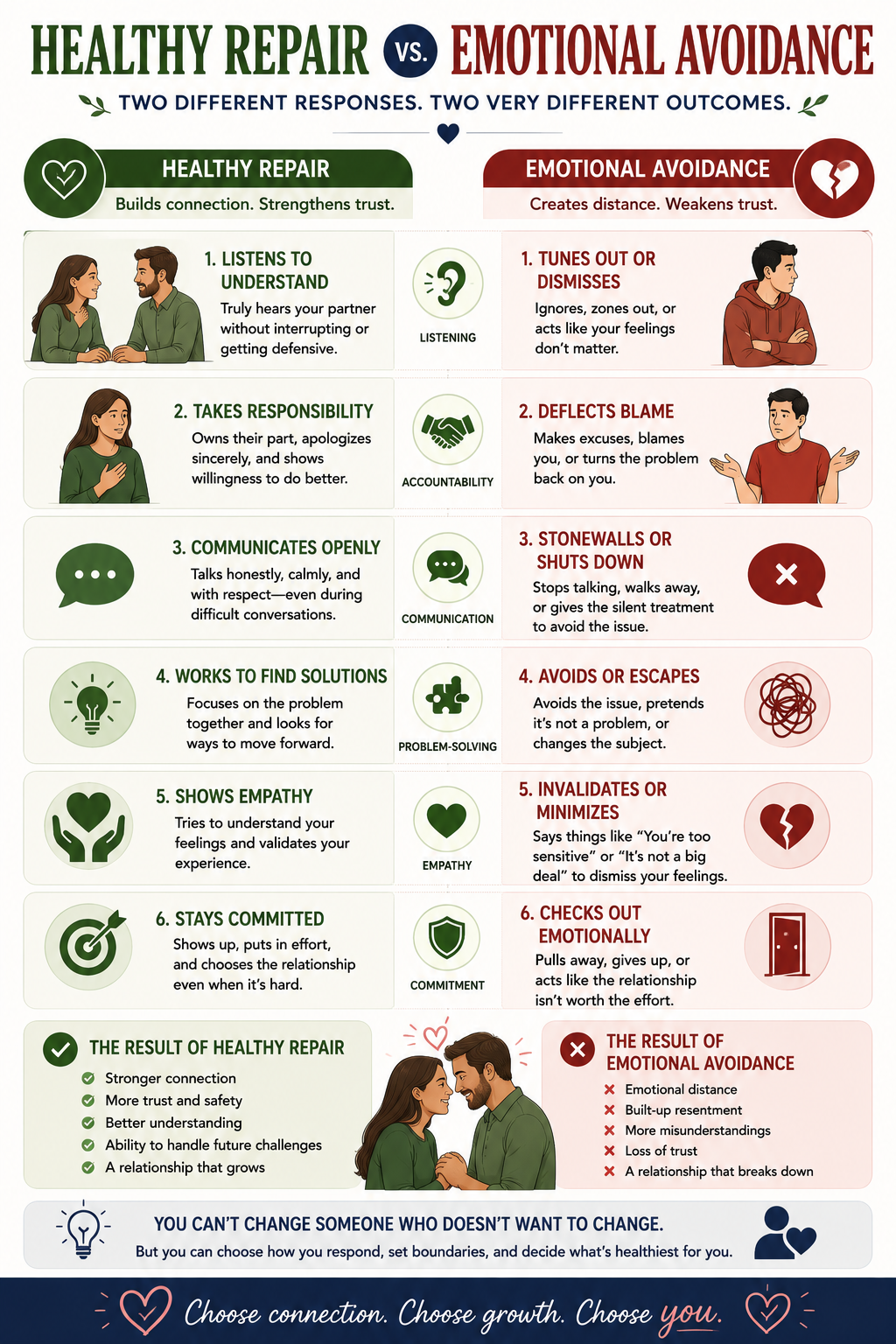
Healthy Repair vs Emotional Avoidance

Here are some ways that you can approach your partner effectively:

  • Making a Positive Connection

People often get defensive when they feel that they are being attacked. Instead of starting a conversation by complaining or criticizing, it’s important to tell your partner that you value the relationship. Talk about how you miss the connection that used to be there, how much you love your life together, and how you want to be closer.

Doing this creates emotional safety instead of resistance. Some experts talk about how emotional tone matters just as much as what’s being said. Conversations that start gently are more productive.

  • Avoid Blame

When someone feels that they are being blamed, they often stop listening and become self-protective. Saying things like:

  • You never care about me.
  • You are always ignoring me.
  • You don’t try.

This can show pain, but then it can turn into defensiveness, and defensiveness doesn’t inspire change. It’s better to focus on describing what you’re feeling instead of focusing on what your partner did wrong. Instead, try to say things like:

  • I feel like we’re disconnected lately.
  • I miss feeling emotionally close to you.
  • I’m scared we’re falling apart.

This change can help to turn the conversation from defensiveness to care.

  • Setting Boundaries

Having healthy boundaries is important, but they can also create resistance instead of cooperation. There is a difference between saying, “I need us to be serious because the relationship matters,” and “If you don’t change, I’m done with you.”

The first conversation invites partnership and communication, and the other one invites shutdown, fear, and emotional withdrawal.

Boundaries need to have emotional honesty and leave room for solution, and not be rude or hurtful.

  • Forcing Others to Change

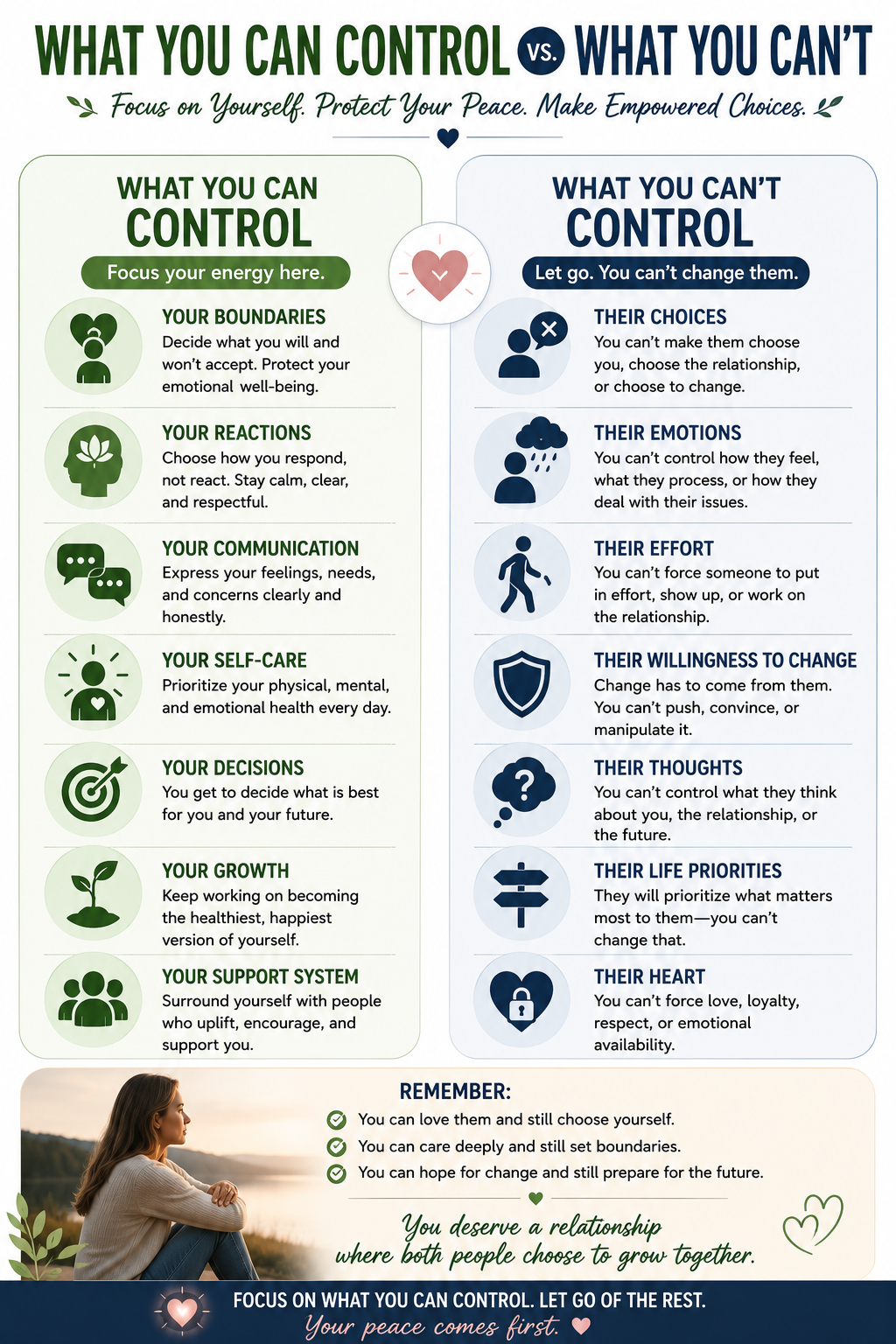
One of the things that people need to realize is that you can’t control what people do. If your partner isn’t willing to grow or communicate, that is something you can’t change.

Accepting this doesn’t mean you give up on the relationship; it means that you set limits on the relationship. Trying to force your partner to be emotionally open might cause more resistance. Real change comes when people feel understood, emotionally safe, and motivated without pressure.

This can be empowering because it redirects your energy to what you can change.

What You Can Control vs What You Can’t

What To Do If Your Partner Refuses Change

Here’s what to do if your partner refuses to change:

  • Improve Communication Skills

If your partner resists what you’re doing, make positive changes in how you communicate. Learning to actively listen, to have patience, and to have healthy conflict resolution can reduce stress and create more openness as time goes on.

In some relationships, one partner will change their unhealthy habits, and this can change the environment for everyone involved.

  • Have Positive Experiences Together

Not all relationship conversations have to be about problems. Sharing positive experiences together can rebuild the emotional connection faster than always talking about problems. Plan to do things together like traveling, fun activities, reconnecting physically, or laughing.

When you create positive memories, it can fix emotional closeness, whereas always talking about relationship problems can cause more damage. Couples that have a real friendship and share enjoyable times together can work through hard situations more successfully.

  • Unrealistic Expectations

Relationships today often think that one person is in charge of creating a good relationship. Some people unconsciously think that their partner should be their:

  • Therapist
  • Best friend
  • Soulmate
  • Financial planner
  • Entertainment
  • Healer
  • Teammate
  • Companion

No one person can do all of these things and perfectly fill every role. Healthy relationships mean having emotional fulfillment between connections, hobbies, family, personal growth, friendships, and one’s own identity.  By recognizing this, it can reduce the pressure on the relationship.

  • Getting Outside Help

Getting outside support doesn’t mean that your relationship is failing, and sometimes this kind of guidance can help couples to talk more effectively and to understand each other better.

Using books, education, communication workshops, self-development, and counseling can be valuable tools.

The National Institutes of Health talks about how relationship education and emotional communication skills can help to bring long-term relationship satisfaction and conflict management.

Even small improvements in the relationship can create big changes as time goes on.

Final Thoughts: Relationships and Phases

Long-term relationships have times of distance, closeness, growth, stress, and emotional changes. Falling in love might feel easy at first, but keeping emotional intimacy requires patience, adaptability, and mutual effort that is ongoing.

One thing to remember is that hard times don’t mean that the relationship is broken, and people can rebuild stronger emotional bonds even after a time of struggle. When partners are willing to try to understand each other better, healing can come.

The first step to healing is getting past assumptions, blame, and panic and having curiosity, compassion, and calm communication.

Frequently Asked Questions

1. What should I do if my partner won’t work on the relationship?

Start by having one calm, honest conversation about what you need and how the relationship is affecting you. If they still refuse to participate, focus on your boundaries, emotional health, and next steps.

2. Can one person fix a relationship alone?

No. One person can improve communication, set boundaries, and work on personal growth, but a healthy relationship requires effort from both partners.

3. What are signs my partner is avoiding relationship problems?

Common signs include changing the subject, shutting down, blaming you, refusing serious talks, dismissing your feelings, or promising change without action.

4. What is emotional avoidance in a relationship?

Emotional avoidance happens when someone refuses to face difficult feelings, conversations, accountability, or relationship problems.

5. What is healthy repair in a relationship?

Healthy repair means both partners are willing to listen, take responsibility, communicate respectfully, and work toward solutions after conflict.

6. How do I know if my relationship problems are fixable?

Problems are more likely to be fixable when both partners show respect, accountability, emotional safety, and a willingness to make real changes.

7. What if my partner says everything is fine but I’m unhappy?

Your feelings still matter. A partner does not have to agree with your experience for your needs, concerns, and emotional pain to be valid.

8. Should I keep asking my partner to change?

You can clearly explain what you need, but repeatedly begging or pleading often leads to exhaustion. After that, it may be healthier to set boundaries and observe their actions.

9. What boundaries can I set with an emotionally avoidant partner?

You can set boundaries around disrespect, repeated avoidance, unhealthy arguments, emotional neglect, and how long you are willing to stay in the same pattern.

10. Is it normal to feel lonely in a relationship?

It can happen, especially when emotional needs are ignored. However, feeling lonely all the time may be a sign that the relationship needs serious attention.

11. What if my partner refuses couples counseling?

If your partner refuses counseling, you can still seek individual support. Personal guidance can help you understand your options and protect your well-being.

12. How can I stop over-functioning in the relationship?

Stop carrying every conversation, apology, plan, and repair attempt by yourself. Give your partner room to show whether they are willing to participate.

13. What does a one-sided relationship look like?

A one-sided relationship often feels like one person is always initiating, apologizing, explaining, compromising, and trying to keep the connection alive.

14. Can emotional avoidance become emotional neglect?

Yes. When avoidance becomes a long-term pattern, the other partner may feel unseen, unsupported, and emotionally abandoned.

15. How do I communicate with a partner who shuts down?

Keep your words clear and calm. Use specific examples, avoid attacking language, and ask for one concrete next step instead of trying to solve everything at once.

16. What if my partner gets defensive every time I bring up problems?

Defensiveness can block repair. Try naming the pattern calmly, but if it continues, focus less on convincing them and more on what you need to feel emotionally safe.

17. When should I stop trying to fix the relationship?

You may need to stop trying when your partner repeatedly refuses effort, ignores your pain, breaks trust, or makes you feel emotionally unsafe.

18. How do I know if it is time to walk away?

It may be time to walk away if the relationship consistently harms your peace, your needs are dismissed, and there is no real willingness to change.

19. Can love be real even if the relationship is unhealthy?

Yes. Love can be real, but love alone does not make a relationship healthy. Respect, effort, safety, and accountability also matter.

20. What is the healthiest thing I can do right now?

The healthiest first step is to stop focusing only on changing your partner and start asking what you need, what you can control, and what protects your peace.

What Does a Jaguar Dream Mean?

What Does a Jaguar Dream Mean

Do you ever dream that you are surrounded by something awesome, like a jaguar? When you understand why you might dream of a jaguar, you can see what your subconscious mind is trying to show you. These are cats that are very large and have a lot of power. The jaguar comes to bring you a message and to help you to open up your intuition.

The meaning of a jaguar dream can mean that you are surrounded by mysteries in your life and that you need to build a bridge between your unconscious and subconscious mind. By doing this, you can be more aware of what is going on in and around you.

A jaguar in your dreams can mean that you are on a path of personal growth. It can mean that you have potential that you might not even realize, and it’s waiting for you to discover it. The dream can help you to move forward on your life path, and if you pay attention to what a jaguar dream means, you might understand your journey more.

Dreaming of a jaguar might mean that you need to embrace the power within yourself. This dream might tell you that you need to move forward and make different decisions. This dream can happen when you need more wisdom and when you need to have strength in your life. Seeing a jaguar will tell you that you need to overcome things in your life that are holding you back, and you need to move forward in your personal journey.

What It Means to Dream of a Jaguar

Dreaming of a jaguar is never random; it’s a powerful symbol that comes with deep meaning. Across many cultures, especially in ancient times, jaguars were seen as sacred animals. When one shows up in your dream, it often points to something strong and instinctual waking up inside you. It can mean you’re reconnecting with your inner wisdom, the kind that doesn’t need words—just knowing.

These animals have always symbolized power and transformation. A jaguar moves with confidence between the light and the dark, and dreaming of one may reflect your own ability to move through different parts of life, your fears, your hopes, and everything in between. It can be a sign that you’re learning how to balance your strength with your sensitivity.

In many spiritual traditions, jaguars were seen as protectors and guides. If you see one in your dreams, it may be reminding you that you already have the strength to handle what’s in front of you. Trust your instincts, they’ll lead you exactly where you need to go.

Jaguar Dream Decoder (Choose What Happened)

How to Understand What the Jaguar Is Telling You

The meaning of a jaguar dream often depends on what the jaguar is doing and how it makes you feel. These dreams tend to show up when something important is happening in your life, so don’t brush them off. Whether the jaguar is watching, attacking, walking beside you, or playing, it all matters. Each version brings a different message.

If the jaguar is calm and just observing, it might be a message about stillness and self-awareness. If it’s being playful, it could point to creative energy trying to surface. If it’s aggressive or chasing you, it might be showing you a fear or challenge you haven’t fully faced yet, but it’s not meant to scare you. Even difficult dreams like that can mean growth is on the way.

Pay close attention to how you feel in the dream. Were you afraid, or did you feel powerful? Were you alone or surrounded by others? Your emotional reaction can reveal just as much as the jaguar’s behavior. Sometimes the most intense dreams are the ones preparing us for the biggest breakthroughs.

The Deeper Psychology of Dreaming About Jaguars

When you look at jaguar dreams from a psychological angle, they often point to the parts of ourselves that live beneath the surface. These dreams aren’t random; they usually come up when something deep within you wants attention. Jaguars represent raw instinct, personal power, and the “shadow” self—those pieces of who we are that we don’t always show the world.

A jaguar in your dream might be asking you to stop hiding your strength. Maybe you’ve been downplaying your confidence or second-guessing your decisions. Psychologically, this kind of dream is a push to step into your own authority and recognize what you’re capable of.

Since jaguars are solitary by nature, dreaming of one might mean it’s time to spend more time alone, reflecting, growing, or just listening to yourself. It’s a reminder that sometimes the most powerful growth happens in silence, away from the noise.

From a depth psychology point of view, the jaguar helps us look at how we deal with fear, control, and change. Do we run from what we don’t understand, or do we face it with steady eyes? A jaguar might appear in your dreams as a guide, helping you reconnect with your inner wisdom and reminding you that you already have the strength to face what’s ahead.

Spiritual and Mythological Meaning of Jaguars in Dreams

Long before modern psychology, ancient cultures already understood how powerful jaguars were. Spiritually, these animals were seen as creatures that could move between worlds, messengers from the unknown. In dreams, they can carry that same energy, showing up as protectors, guides, or symbols of awakening.

The Maya and Aztecs saw jaguars as deeply spiritual beings. They were connected to transformation, mystery, and divine authority. In dream work, seeing a jaguar often means that you’re being called to step into something more, something sacred. The jaguar doesn’t fear the dark; it moves through it with ease. That’s the message: you can navigate uncertainty with grace, even when you don’t have all the answers yet.

In shamanic traditions, jaguars were seen as guardians and spiritual warriors. So, if one appears to you in a dream, it might mean that your own spiritual strength is waking up. You may be ready to go deeper into your path—whether that’s healing, trusting your intuition more, or simply standing taller in your truth.

These dreams are invitations. They whisper, “You’re stronger than you know. And you’re ready for more.”

Common Dream Scenarios Involving Jaguars

When a jaguar shows up in your dream, the setting matters. Where you see the jaguar, whether in the wild, a busy city, or even inside your own home, can completely shift the meaning. These different environments reflect different parts of your life, and the jaguar’s presence in each one holds a message worth paying attention to.

If you see a jaguar in the jungle or a forest, it may connect to your natural instincts or untamed emotions. It’s the part of you that knows how to survive, even when life gets complicated. If the jaguar appears in a city or an unfamiliar place, it could be highlighting your ability to adapt or showing you where you feel out of place. When a jaguar enters your home in a dream, that usually means something personal is rising to the surface, an issue or emotion you may need to face in your daily life.

The key is to notice not just where the jaguar is, but how it behaves and how you feel in its presence. Are you afraid? Calm? Curious? These feelings offer clues about what part of your life is calling for strength, awareness, or change.

  • What If the Jaguar in Your Dream Is Friendly?

A jaguar that is being friendly can mean balance. It often means you’re working in harmony with your own inner power, embracing strength without fear, and trusting your instincts without pushing too hard. This kind of dream can reflect emotional maturity, personal growth, and a calm confidence in how you’re moving through life.

  • Are All Jaguar Dreams Spiritual?

Not always, but they can be. While jaguar dreams often carry spiritual energy, especially for those who walk a conscious or intuitive path, they can also point to more personal themes. You might be facing a big change, dealing with hidden fears, or coming into a deeper sense of who you are. The dream meets you where you are, and the jaguar is there to help you navigate it.

  • Why Do Jaguar Dreams Keep Coming Back?

If you’re dreaming about jaguars over and over, take that as a nudge from your subconscious. There’s likely something important you haven’t fully acknowledged yet. Maybe it’s a strength you haven’t tapped into or a part of yourself you’ve been avoiding. Recurring jaguar dreams usually mean there’s a lesson trying to reach you. Don’t ignore it, but lean into it.

  • Do Jaguar Dreams Predict the Future?

Jaguar dreams don’t usually tell you what will happen; they help you see things more clearly as they are now. They reflect your own intuition about your life. Instead of giving a concrete answer, they offer wisdom, perspective, and guidance for making empowered choices. If you trust the dream, it can help you navigate what’s ahead.

  • How to Remember Your Jaguar Dreams?

Always try to keep a notebook or dream journal by your bed. As soon as you wake up, jot down anything you can remember: the setting, the emotions, how the jaguar behaved, and how it made you feel. Even the small details can hold important meaning. Over time, these notes can help you piece together a bigger message.

Final Thoughts

Ultimately, no dream book or interpretation guide can tell you exactly what your jaguar dream means. That understanding comes from within. Ask yourself: What’s going on in my life right now? Where do I need more courage, clarity, or power? What part of me feels wild, unseen, or ready to awaken?

The jaguar always shows up for a reason. Its presence is a powerful invitation to face your fears, claim your inner strength, and begin stepping into your truth. Whatever message it brings, it’s meant for you.

So, trust what you feel, explore what it might be trying to show you, and let the wisdom of this sacred animal lead you toward growth and self-awareness.

How to Tell If Your Dreams Are Actually Psychic Messages

How to Tell If Your Dreams Are Actually Psychic Messages

When Your Dreams Are Vivid

Have you ever woken up to a dream that was so vivid that it stays with you all day? This is a dream where the details seem like a reality, and the dream is full of emotions and electricity. Many people will think of these dreams just as something weird or part of your brain having memories, but those who are psychics, empaths, and spiritually sensitive people know that some dreams aren’t there just for you to dream but to give you a message.

Dreams have been talked about throughout history as a way for people to get guidance. Even during ancient Greek times, people would go and sleep in the temples so that they could have dreams about healing. In the Indignis cultures, dreams were seen as communication from the ancestors. Even psychics today talk about dreams as a way that the universe can transfer energy and give you messages when your logical mind is sleeping.

The question really is, “How do you know if what you dreamed was just something random or if it was an actual psychic message?” Some people wonder if there’s a difference between intuition and symbolic processing, and how do they stop themselves from overanalyzing everything that they see while being open to psychic and spiritual insight.

As you read on, you’ll see how this article talks about your dreams and about psychic data. The article will look at the differences between having just a regular dream and having a dream that carries an intuitive message. It’ll talk about what science and spirituality say about dreams and how to know if you’re having a psychic dream or if you’re having a night vision. After you finish reading the article, you’ll know about dreams, and you’ll learn if the dream was there to give you a message or if it happened because you were stressed. This article will show you if you are getting messages from your higher self about upcoming changes while you dream.

According to the  Sleep Foundation, around half of all people in the world have had at least one precognitive dream over their lifetime. This is a dream that seems to be able to predict a future event. Some psychics believe that the number of these dreams is even higher for people who are intuitive or for empaths because they are able to tune in to higher frequencies better. Maybe your dreams are a language to your psychic self that is there to show you things if you can learn how to be open and how to listen.

What is a Precognitive or Psychic Dream?

Not every dream that someone has is going to feel like a psychic or precognitive dream. There are some dreams that help people to release their emotions, and some are symbolic of fears that someone has when they are awake. But there are some dreams that have an energy that stands out from all the other dreams. These are the dreams that make you stop and wonder, “Did that dream mean something?”

According to  Keen.com, here are four different types of psychic dreams:

  • Precognitive dreams: Dreams that show future events.
  • Telepathic dreams: Dreams in which you pick up thoughts or emotions from another person.
  • Clairvoyant dreams: Dreams where you are able to see things in real time that are happening somewhere else.
  • Symbolic dreams: Dreams that give a message from ancestors, spiritual guides, or even your higher consciousness.

Some skeptics might say that these kinds of dreams are part of a person’s selective memory, where they’re just remembering dreams that fit what’s going on in their lives, while others believe that these dreams are just coincidences. But according to a study from the University of Edinburgh’s parapsychology unit, it shows that people who write down their dreams regularly are often able to verify the dreams to be more accurate than those who don’t. This shows that these dreams aren’t about coincidence or chance.

The  Sleep Foundation says that dreams can be memories that are consolidated that showing future possibilities, so that people can have more problem-solving skills. This, and even science, says that this could be looked at as similar to intuitive forecasting. When your conscious mind is relaxed, your psychic sensitivity increases on its own.

This means that when you’re dreaming, your dream might not be producing new information, but it might just be receiving information. There are some psychics who talk about REM sleep, and they say that when a person is in this kind of sleep, the energy field expands beyond a person’s boundaries and can go to a psychic network. Carl Jung called this “collective unconsciousness.” While dreaming, a person can tune into their emotions, symbols, and timelines that haven’t happened in their waking life yet.

Having an intuitive dream might mean that you dream of a friend calling you for help and then wake up to find out that your friend was dealing with something hard at the same time you had the dream. Another example of this could be that you dream of standing under a bright colored sky, and then later you see the same image in the news during something like a wildfire a few weeks later. The connection isn’t chance or coincidence or even your imagination, but it’s significant.

Knowing the Difference Between Subconscious Thought and Psychic Messages

Signs Your Dream Might Be Psychic

Here are some ways that you can know the difference between subconscious thought and psychic messages:

  • Subconscious thought or dreams cause stress, insecurity, and only give random details.
  • Psychic dreams are full of information, are vivid, full of emotions, and are not normal dreams that you have.
  • Psychic dreams have smells, temperatures, and even sounds that other dreams don’t have.
  • Psychic dreams have feelings of being told something and not just witnessing something.

In his book,  An Experiment with Time, by J.W. Dunne, published in 1927, he showed that dream fragments are often referred to as future and past experiences. This suggests that the human mind might see time as nonlinear while they are sleeping. Dunne’s data agreed with what psychics have said for years, that the soul can move outside a timeline or a chronological sequence.

Psychics today talk about intuitive dreamers and say that psychic dreams aren’t about predicting disasters but more about giving someone guidance. The dreams aren’t meant to scare someone, but they’re meant to tell them to change direction, call the person that called you back, or to change their mindset, over talking about an impending disaster.

This is why psychic dreams are different. They aren’t meant to cause anxiety, and they have calmness and clarity, even when they are vivid and the imagery is intense.

Energy Signatures Behind Psychic Dreams

Energy Signatures Behind Psychic Dreams


Here are a few energy signatures that separate a psychic dream from any other dream. When you wake up, you know that the dream you had was different and not just a regular dream. These signs aren’t just about chance or superstition, but they are real-life experiences from people who are empaths, psychics, and even dreamers, all around the world!

Vivid Dreams Beyond Reality

Psychic dreams bring a sense of clarity. The dreams are vivid, and this means the colors are brighter, the sounds are clear, and the sensations feel physical. You might even remember how heavy something felt, like a coin, a feather, or a key in your hand, or how hot or cold your skin was in your dream. According to the  Sleep Foundation, vivid dreams are linked with REM activity and emotional processing. Both of these things help to enhance the psychic messages that you are receptive to. When you look at this as energy, vivid dreams send a signal that the message wasn’t made up by your imagination, but that it was a message sent to you.

Emotional Pull and Inner Certainty

Sometimes you wake from a dream so vivid it leaves your chest tight or your eyes wet, but beneath the emotion, there’s a quiet realization, and you know it mattered. Psychic dreams often carry that unmistakable afterglow, a feeling that clings to you long after you’ve opened your eyes. It’s more than memory; it’s a deep inner certainty, a gut-level awareness that what you saw or felt was true on some level. Even if the details don’t make sense yet, something inside you recognizes the truth woven through it.

Clear Symbols

According to annasayce.com, most regular dreams have symbols that seem to take hours to figure out. Psychic dreams seem to have a way to translate the dream almost immediately. The answer or the symbol of the dream will be obvious. You might see a closed door, for example, and you already know that this means that some kind of relationship is coming to an end. Anne Sayce, an intuitive teacher, says that these are psychic dreams that are sent by the spiritual world, and they are meant to be self-interpreted, meaning the message is given to you instead of being hidden.

Signs and Synchronicities

One of the biggest signs that you had a psychic dream is when the events happen just as you dreamed them. Maybe you dream of losing your phone while you’re in water, and the next day, you drop your phone into the toilet. Or you might dream of meeting someone who has on a red jacket, and then a few hours later, you run into someone who has on a red jacket. These are psychic dreams that help to show you reality quickly. According to the  Dream Network Journal, synchronicities are some of the strongest signs that you’ve had a pre-cognitive dream because they take the subjective experience and give it objective verification.

When your dreams are vivid, have strong emotions, and instant meaning, and it seems like something in reality, these signs can show you that you’re having a psychic or precognitive dream.

The Differences Between Psychic Dreams

The Differences Between Psychic Dreams

Just like psychic gifts are different and come in different forms, so do psychic dreams. Not all psychic dreams are going to be the same. It’s important that you can distinguish between the kinds of dreams that you have had so that you can interpret them correctly. Here are some of the different kinds of dreams and what they mean:

1. Dreams That Glimpse the Future

These are the ones people recognize most easily. They show real events before they happen, like sometimes the next day, sometimes months later. The Sleep Foundation describes them as dreams that seem to reveal the future without any logical explanation for how you could have known. Imagine dreaming about a car accident on a bridge and later seeing the same scene on the evening news.

A dreamer once wrote in her journal about “a trembling sea glowing red,” three days before the 2011 earthquake struck Japan. She didn’t consciously know where the image came from, but her entry matched the disaster almost perfectly.

2. Dreams That Connect Minds

These are telepathic dreams, like moments when emotion, thought, or energy passes between two people while they sleep. They’re most common between people who share a strong bond. A mother might dream her child is crying, only to find the child awake and unwell in another room. These dreams aren’t about prediction; they’re about connection. It’s as if the heart sends out a signal and another heart receives it, no words needed.

3. Dreams That See What’s Happening Now

Clairvoyant dreams reveal events occurring at the same time somewhere else. You could dream of a friend losing something precious, then wake to a message confirming it happened. Researchers have explored this through remote-viewing studies, suggesting that during sleep, the mind becomes more open and able to pick up information it normally filters out. The relaxed dream state seems to give intuition more room to breathe.

4. Dreams That Teach or Comfort

These dreams feel sacred. You might meet a loved one who has passed on, a spiritual guide, or a radiant figure offering reassurance. The atmosphere is peaceful and full of light, and the message is usually simple, like healing, protection, or encouragement. Many people describe these as “teacher dreams” because they feel like lessons for the soul rather than predictions. One dreamer shared that her grandmother appeared, handed her a white feather, and said, “You’re safe.” Two weeks later, her life shifted in a positive new direction, proof that spiritual dreams can soothe and prepare us at once.

5. Dreams That Belong to Everyone

Sometimes, we dream not just for ourselves but for the world. These are collective or archetypal dreams like visions that mirror what’s stirring in the collective consciousness. People have reported seeing floods, fires, or social movements in dreams months before they happen. Psychologists might call them archetypal; psychics might say they’re glimpses into humanity’s shared energy field. Either way, they remind us that consciousness is connected.

When you start recognizing these dream types, you begin to see their purpose. Each one has a reason for showing up, whether it’s to warn, comfort, guide, or awaken you. Psychic dreams aren’t random fragments of the mind; they’re messages, arriving in the language of symbols and emotion.

Testing Your Psychic Dreams

Even psychics and dreamers want evidence that their dreams are true. There’s nothing wrong with testing your dreams to find out if they are intuition or imagination. This can help you to see your dreams as accurate and to trust yourself even more. This isn’t about proving to skeptics that these dreams are real, but it’s about learning to see your own signs and patterns.

Dream Journaling

Write down the dream that you have right when you wake up. Include the emotions that you felt, the date, and the different people, symbols, and colors you saw. As time goes on, you will see patterns. When something later manifests for you, highlight it or circle it. According to the  Sleep Foundation, journaling is recommended as a way to see if there are recurring themes.

One psychic talked about how precognitive dreams often have timestamps, like a clock on the wall or a calendar with something circled. Writing down every detail can help you to create a database that will help you measure things that might seem like coincidences.

Ask the Spirit Guides

Ask the spirit guides to give you clear dreams. Set a strong intention. Say something like, “Please show me what I need to know about my next step.” The clearer the question, the clearer your dream will be. Energy wants direction.

Be Objective in Coincidences

If you dream about rain, for example, on a sunny day and it rained later, that could be the weather, but if you dream about a purple umbrella on a rainy day in the street and you see that, write that down because that is an exact hit.  By tracking these things, you can realize what you have made up and what signs are real.

Practice Dreaming

Try to practice dreaming and intentionally avoid spiritual practices. See if you have dreams or if they only happen when you are being intentional. If you are having psychic dreams consistently with accuracy, you will see that your intentions can make the connection stronger.

Find People You Can Trust

Find someone that you can trust to discuss your dreams with. Find intuitive circles or communities. You can even look for psychic development groups. Sharing these dreams can help to validate when you see common themes that other people might have had. According to the  Dream Network Journal, sharing dreams can make your intuition stronger by giving feedback between the dreamers and real-world situations and outcomes.

How to Interpret Your Dreams

Psychic dreams usually won’t just give you a plain message, but they come in symbols, feelings, and even metaphors. The important thing is to learn to interpret the dream without trying to force a meaning. Here’s how!

Personal Symbols

Dreaming of a snake might mean change for you, but it could mean wisdom or fear for someone else. Instead of just using a generic dictionary, ask how you felt in the dream and look at the emotions.

Recurring Dreams

When you dream of an image over and over again, like an ocean, stairs, or a door that’s not a random thing. Repetition makes you notice it. The spirit world will try to get you to decode the symbol or the sign, and it is a language between you and the spiritual world.

Pay Attention to Context

Dreaming of losing your wallet might mean that you have a bad financial week, but more than likely, it’s just about stress. But if you dream of losing your wallet when things are calm and then you really lose it, it could be a psychic warning. The emotions and tone can reveal where the dream comes from.

Find the Interpretation

There are some dreams that are easy to interpret. You might hear a voice that says, “This dream isn’t about money, but it’s about having trust.” That is a direct communication and translation. Anna Sayce at annasayce.com says that the origin of the dream can have its own message, so that it can’t be misinterpreted.

Forcing the Answers

Not every dream is about predicting events. Sometimes the psychic world will use symbols to help you understand the emotions you are having. A dream of a storm might be about your emotions and not about meteorology. Don’t overinterpret the dream because this will cause stress and make you less sensitive to the spiritual world. Psychic awareness isn’t about fear but about being curious.

Don’t Just Use Logic

Truth will show up through your alignment. If you dream about something and it guides you to improve your life, like you make a change in a plan after a warning dream to find out you stayed out of trouble, then this is enough proof. Psychic dreams aren’t about winning a fight but about balancing peace with your inner and spiritual life.

Keeping the Perspective: Risk and Skepticism

Psychic dreams can open amazing doors, but they can also stir up confusion if you don’t stay centered. Learning to question what you see helps you stay balanced and calm instead of overwhelmed.

Where Science Stands

Researchers agree that dreams sometimes piece things together before the conscious mind does. Studies show that the brain sorts through emotions, body signals, and bits of information while we sleep. Sometimes that mix looks like a prediction, though science hasn’t called it paranormal. It’s fair to say the topic is still a mystery.

That doesn’t make psychic dreams false. It just means science hasn’t yet found tools to measure something that works through feeling rather than data. Empathy and intuition can’t really be weighed or timed.

The Pattern Trap

Our minds love connecting dots even when they don’t belong together. Maybe you dream of turbulence and later see a headline about a delayed flight; the two might not actually link. Writing everything down helps keep things real. Note the dreams that miss as much as the ones that land. Over time, you’ll see what’s genuine and what’s a coincidence.

Feelings Versus Intuition

Not every strong dream is a message. Fear can sneak in and pretend to be guidance. You’ll know the difference by how it feels afterward. True intuitive dreams leave you calm and clear, even if the topic is serious. Fear dreams feel messy, jumpy, or draining. If that happens, clear your energy so take a salt bath, breathe, meditate, or just rest.

Staying Grounded

Once you notice your dreams can point toward truth, it’s easy to start treating every image like a sign. But dreams are helpers, not rulers. They give direction, not commands. Think of them like a map; you still decide how and when to travel.

Using Care With Others

Sometimes dreams seem to involve friends or family. Be gentle with what you share. Dream language is symbolic; a car crash might simply mean “slow down.” When in doubt, talk softly, not dramatically. Offer support, not fear.

Keeping a gentle, questioning attitude doesn’t dull your gift, but it strengthens it. The best dreamers walk a middle path: open to messages, but smart enough to double-check what they receive. Intuition grows stronger when it’s paired with calm curiosity.

Nurturing Psychic Dreams

Psychic dreaming isn’t something that happens by accident, but it grows stronger the more care you give it. When you treat sleep as a sacred space, your mind learns to recognize messages from a higher source more clearly.

Create Calm Before Bed

Evenings hold special energy. Turn off your phone, lower the lights, and let your breath slow down. Before you fall asleep, say something simple like, “Only messages for my highest good are welcome tonight.” This small step keeps your dreams clear and loving instead of random or heavy.

Plant a Question Before You Sleep

Long ago, people used to rest in temples and ask for dream answers. You can do something similar. Write one question on paper, maybe about love, work, or healing, and tuck it under your pillow. Picture a soft golden light around it. That act alone tells your subconscious what you’re ready to learn.

Keep a Gentle Energy Beside You

Some people like to sleep with a crystal or a small symbol near them. Stones like amethyst, moonstone, or labradorite seem to calm the mind and help filter the chatter that can cloud intuition. Hold one in your hand for a moment before bed and imagine its color forming a soft glow around you.

Hold Onto the Dream When You Wake

When morning comes, stay still. Don’t grab your phone or jump up. Replay what you remember and whisper it out loud if it helps. Then touch something solid—a wall, the floor, your nightstand to anchor the memory. Dreams slip away fast, but grounding keeps them from fading.

Use Meditation to Bridge Worlds

A few minutes of meditation before bed can make it easier to realize you’re dreaming when it happens. In that lucid state, you can actually ask the dream questions like, “Are you showing me a symbol, or a real event?” The answers often come as feelings or clear words.

Cleanse and Protect Your Energy

Sometimes psychic dreams feel too strong. If that happens, reset your energy before sleep. Burn sage if that feels right, or simply say, “I release anything that doesn’t belong to me.” Protecting your space keeps you rested instead of drained.

Invite Familiar Helpers

If you work with guides, ask them to appear in ways you’ll recognize, maybe as light, an animal, or a color. You might notice that the same sign returns whenever a message carries truth or healing. These repeating symbols build trust between you and your unseen helpers.

Honor Your Rhythm

There will be nights full of messages and others that feel quiet. Don’t force it. Dreams flow in cycles like the moon. When your body is cared for, hydrated, peaceful, and rested, the messages come naturally.

Psychic dreaming isn’t about control; it’s about partnership. When you approach it with respect and calm, your dreams start to speak more clearly, showing you what your waking mind might have missed.

Real-Life Examples of Psychic Dreams

People love to hear stories because they help them to believe. When people hear true-life stories of psychic dreams, something awakens inside of them. They know that intuition is real. These examples show historically and now how dreams carry messages that are beyond logic.

Lincoln’s Dream

Before he was assassinated, Abraham Lincoln told people around him that he had dreamed of walking around the White House and found his own funeral in the East Room. When he asked the guard who died, they said, “The president.” This was one of the most well-known examples of how a precognitive dream plays a part in a historical event. It shows how important figures and not just psychics have used dreams and intuition.

The Aberfan Warning

There was a coal waste slide that happened to a school in Wales in 1966, and there were many people who reported having dreams about black mud, darkness, and fear. Even children said they had these dreams. Some woke up screaming and crying and felt that something bad was coming. After the disaster struck, researchers had more than a hundred reports like this. This is one of the best-known examples of shared premonition and was later investigated by the British Premonitions Bureau. People today remember this and see how this can be part of human connectedness to dreams.

The Dream Journaler

A woman from California decided to write down every dream she could remember for a full year. By the end, she had hundreds of entries, everything from tiny details to vivid, emotional scenes. When she compared them with later events, more than forty matched real-life situations. Some were lighthearted, a friend changing her hairstyle. Others were deeper, like a dream about new doors opening right before she received an unexpected job offer. She also noticed that her most accurate dreams often came around full moons or during stressful times, suggesting that emotion and lunar energy might heighten sensitivity.

The Nurse Who Listened

One night, a nurse dreamed she was sprinting down a hospital corridor, shouting, “Room 314!” The fear in the dream jolted her awake. The next day, while working her shift, she was stationed near that same room. A sudden instinct made her check inside, just in time to catch a patient in distress. Her quick action saved his life. She later said that moment changed her. What she once brushed off as a coincidence became proof that something unseen might be guiding her.

Dreams in Science and Story

In the early 1900s, an engineer named J. W. Dunne began studying how dreams might stretch through time. He asked people to record their dreams and later compare them with real events. His findings suggested that dreams sometimes included fragments of the future as well as the past. Though simple by modern standards, his work inspired scientists and writers alike, including Aldous Huxley and J. B. Priestley, to explore how time and awareness intertwine.

Everyday Signs

Psychic dreaming isn’t just for researchers or mystics. Thousands of ordinary dreamers share their stories online. One person wrote about dreaming that an old friend sent her a message saying, “I miss you,” followed by a sunflower emoji. When she woke up, that exact text was waiting on her phone. Moments like these might seem small, but they remind us that intuition speaks quietly through ordinary life.

Across all these stories runs one clear thread: psychic dreaming doesn’t belong to a chosen few. It’s a natural sense that everyone has, waiting to be noticed. The difference isn’t ability, but it’s awareness.

Final Thoughts: Dreams and the Psychic World

Dreams are part of the psychic world. Before there were any kind of spiritual apps like astrological or meditation apps, people relied on dreams to help them to know when to harvest and how to understand their destiny.

When dreams wake you up out of a deep sleep, don’t think of it as something strange, but instead try to find out what information the dream is giving you. What if the universe were able to text your phone while you’re sleeping?  This is what dreams are: the universe is texting you through your dreams, which shows that your conscious mind is like a sponge and is ready to hear the messages.

Believing in a psychic dream doesn’t mean you don’t believe in logic or science, but it means you are reaching further and deeper into what the universe has for you. Neuroscience shows us that REM sleep helps to increase intuition and pattern recognition. Psychics call this a download from the universe, and this might be something that science just hasn’t named yet. The bridge between psychology and psychic work isn’t a fantasy, but it’s a growth.

You don’t have to know everything right away. Start small and keep a journal by your bedside. When you dream, write it down in detail. Practice trying to figure out what the dream means and look for patterns. You will see how your dreams are like training your intuition. This is something the soul picks up before you even get out of bed.

Each dream that you have can show you that there is reality in everything that happens, even in dreaming. Dreaming consciously means that you are a part of creation and you are learning about it one symbol at a time. You will see how your dreams are training you to listen to your intuition more. The universe is talking to you, and the only thing that you have to do is to listen and believe.

FAQ

  1. What is a psychic dream?
    A dream that contains verifiable information, clear guidance, or accurate foresight that cannot be explained by ordinary memory, logic, or coincidence.

  2. How are psychic dreams different from regular dreams?
    They feel vivid, urgent, emotionally crisp, and often include unusual clarity, symbols that stand out, or details that later prove true.

  3. Are all vivid dreams psychic?
    No. Vividness helps you recall a dream, but psychic quality usually includes specific evidence, timing, or guidance that maps to waking events.

  4. What are common signs a dream is a message?
    Strong emotional charge, repeating symbols, a direct voice or instruction, a “knowing” on waking, or details that later match reality.

  5. Can anxiety cause dreams that feel psychic?
    Stress can intensify dreams. Track outcomes; if messages repeat and match events beyond chance, you may be receiving psychic content.

  6. How can I test a psychic dream?
    Write it down immediately, extract specific, testable statements or dates, and check what happens. Evidence beats vague impressions.

  7. What symbols often appear in psychic dreams?
    Doors (opportunity), phones (communication), water (emotion/intuition), clocks (timing), and luminous light or numbers that repeat.

  8. Do psychic dreams always predict the future?
    Not always. Some provide insight about the present, highlight hidden factors, or offer healing guidance rather than prediction.

  9. How do I reduce wishful thinking or bias?
    Document dreams before analysis, mark what’s literal vs symbolic, and review later with fresh eyes or a neutral reader.

  10. What is the best way to keep a dream record?
    Use a bedside notebook or voice memo on waking; include date, people, symbols, emotions, colors, and any waking “knowing.”

  11. How can I invite clearer psychic dreams?
    Create a pre-sleep intention, reduce screens, avoid heavy meals late, do 3–5 minutes of breathwork, and ask for helpful, verifiable guidance.

  12. Should I share psychic dreams with others?
    Share thoughtfully. Protect privacy and avoid unduly influencing others—especially if timing and outcomes are uncertain.

  13. How do I interpret timing in a dream?
    Note numbers, seasons, moon phases, or calendar cues; sometimes timing is symbolic (e.g., “three” = 3 days/weeks or third attempt).

  14. Can dream messages come from loved ones in spirit?
    Many report evidential visits: accurate personal details, familiar phrases, or unique items. Comfort plus verifiable specifics are key.

  15. How do I handle scary or warning dreams?
    Ground first. Separate fear from facts, list practical actions, and consult professionals if safety, health, or legal issues are involved.

  16. What if my dreams conflict with a psychic reading?
    Prioritize evidence and ethics. Compare notes objectively and make decisions based on a blend of intuition, facts, and free will.

  17. Can anyone develop psychic dreaming?
    Yes. With consistent sleep hygiene, intention-setting, tracking, and gentle practice, most people improve dream recall and clarity.

  18. When should I seek professional support?
    If dreams trigger distress, trauma memories, or mental-health concerns, consult a qualified clinician. For spiritual context, seek an ethical dreamworker or psychic medium.


Manifesting Secrets: The Real Truth Behind Creating the Life You Want

Manifesting Secrets

You are the one who brings things into your life. You choose how you’re going to look at things and how you bring things to yourself. Manifestation is one way that people can turn what they want into something real. It takes the thoughts that you have and uses them for your advantage, as long as they are positive.

The idea of manifestation has been around for years, and it is based on both science and spiritual ideas to help people to grow and to help them to be able to bring things into their lives by taking action and changing their mindset.

There are different ways that manifestation can help you, and here are some ideas behind manifestation:

  • Anyone can use it.
  • It can point you in the right direction in life.
  • There are basic components of manifestation.
  • Find the best method for you.
  • There are several techniques, such as journaling or visualization.
  • You can practice manifesting on your own.

Understanding Manifestation

Manifestation is when you are able to take what you want in your life and make it a reality. This is focusing on what you believe and being positive. It also requires you to align your actions and to change your mindset so that you can attract the outcome that you want. This works with the Law of Attraction, which says like attracts like. It is important that you set goals and that you have clear intentions, as you believe that you can manifest your desires.

How Manifestation Helps Turn Your Thoughts into Reality

Manifestation is one of those things people have always done, even if they didn’t call it that. Long before anyone gave it a name, folks were praying, setting intentions, and imagining better lives, all forms of trying to make dreams come true. The idea is simple: your thoughts have power, and the energy you focus on can shape what happens in your life.

Today, we understand a little more about how this works. At Insight Timer, they’ve combined ancient wisdom with modern tools to help people grow. Whether you’re hoping to feel healthier, find a better job, attract love, or just bring more peace into your day, understanding manifestation gives you a beautiful place to start.

In this guide, you’ll learn five helpful secrets to make manifestation feel more natural. These aren’t rules you have to follow, just helpful tips to get you in the right mindset. Think of it as a way to start feeling aligned with what you truly want.

Quick Takeaways

  • Manifestation is something anyone can try. It can help you get clear on what you want and align your energy with your goals.
  • There are many ways to manifest, and the key is finding what feels good to you.
  • You can use tools like journaling, meditation, and visualization to help you focus your energy.
  • Your thoughts and emotions matter. Manifestation works best when your heart and mind are in sync.
  • Insight Timer offers lots of free meditations to support your journey.

What Is Manifestation?

Manifestation is about bringing your desires to life through focused energy, belief, and action. You set an intention, picture the outcome, feel the emotion of it already being real, and then allow yourself to trust that it’s possible. It’s often linked with the Law of Attraction, which is the idea that the energy you give out is the energy you receive.

That doesn’t mean you can just “think” your way into a new life overnight. But when you align your thoughts, feelings, and actions, you start to move differently, and that changes everything.

What Can You Manifest?

You can manifest just about anything. Some people focus on small wins, like finding a moment of peace in a busy day. Others aim for bigger life shifts, like meeting a soulmate, getting a promotion, or healing from emotional pain.

Whether it’s love, better self-care, financial abundance, or feeling more confident in your own skin, the process is the same. What matters most is your clarity and your willingness to believe that good things are on the way.

The Basics of Manifestation

We manifest all the time, often without realizing it. Every time we worry about the worst or hope for the best, we’re sending out energy that can shape how things unfold.

To start manifesting intentionally, take a moment to think about what you really want. Let it be something that excites you, something that lights you up when you picture it coming true.

Close your eyes and see it in your mind like it’s already happening. Imagine how it feels in your body, the joy, the relief, the peace. The clearer and more emotional the vision, the more power it holds.

Let yourself sit in that feeling for a bit. Let it grow. This is where the shift starts, when you believe you deserve good things, and your whole body begins to respond to that belief.

Techniques That Help Manifestation Work

There are lots of tools and methods to help you manifest your desires. You don’t need to use all of them. Try a few, see what feels right, and go with what resonates.

Vision Boards

Creating a vision board is a fun, visual way to stay connected to your goals. Just gather images, words, or anything that represents what you’re calling in. When you see it every day, it reminds your brain and heart to stay focused.

If your dream is to run a successful business, maybe you’ll include inspiring quotes from leaders you admire or photos of the kind of work-life balance you want to build. Let your board feel personal and energizing.

The 369 Method

This one’s super simple. Write your goal:

  • 3 times in the morning
  • 6 times in the afternoon
  • 9 times in the evening

The repetition helps lock your goal into your subconscious mind and keeps your intention alive throughout the day.

Gratitude Journaling

Gratitude helps shift your energy from scarcity to abundance. When you focus on what’s already going right, you start to notice better around you.

Writing down a few things you’re thankful for each day raises your vibration and opens the door to even more blessings. It’s a gentle way to remind yourself that you’re already supported and more is on the way.

Scripting

This method asks you to write as if your dream has already come true. Describe your life in full detail, as if you’re already living it. Write about how it feels, what’s changed, and how grateful you are.

For example: “I wake up every morning feeling calm and energized in my beautiful home. I’m surrounded by love, purpose, and abundance.” The more vivid your writing, the more real it becomes in your heart and mind.

Positive Affirmations

These are short, empowering phrases that help shift your mindset. Repeating affirmations like “I am worthy of love,” or “Abundance flows to me easily,” can help rewire limiting beliefs and open you up to receiving.

Say them out loud, write them on sticky notes, or repeat them in your head. The goal is to make these thoughts feel natural and believable.

Using Meditation and Visualization

Meditation helps you quiet the noise and reconnect with your inner self. When you add visualization, it becomes a powerful combo. You’re not only calming your mind, but you’re activating your imagination and energy.

Picture yourself already having what you desire. Let yourself feel it. This emotional connection makes your goals feel real, which makes it easier to take inspired action.

Oprah’s Manifestation Story

One of the most well-known examples of manifestation comes from Oprah Winfrey. After reading The Color Purple, she deeply wanted to be in the film version, even though she had no acting experience at the time.

She didn’t just wish for it. She focused on it, prayed, and stayed emotionally connected to that dream. And then one day, she got the call. The role was hers.

She later said she didn’t realize she was “manifesting” at the time, but what she did was align her belief, intention, and focus. That’s what manifestation is all about.

A Simple Manifestation Meditation to Try

Here’s a gentle meditation you can use if you’re just starting out:

  1. Sit quietly and close your eyes. Take a few deep breaths.
  2. Think of one thing you deeply desire.
  3. Visualize it already being real.
  4. Notice how it feels. Where do you feel it in your body?
  5. Sit in that feeling. Let it grow.
  6. Say thank you even if it hasn’t happened yet.
  7. Breathe it in. Trust it’s on the way.

5 Real Ways to Make Manifestation Work for You

Manifestation isn’t just about daydreaming or hoping something shows up. It’s about tuning into what you really want and then gently shifting your thoughts, energy, and actions to line up with that vision. You’re not forcing anything, but you’re allowing it to come together by getting clear, staying open, and following the nudges that feel right.

If you’re looking to bring something into your life like love, healing, peace, or anything in between, these five tips can help you get into the right rhythm and energy for manifestation to actually work.

  1. Know What You Want Clearly

It sounds simple, but the truth is that many people struggle to ask clearly for what they want. They either send mixed signals to the universe or get stuck in fear, thinking they don’t deserve it. That’s why clarity matters.

When you sit down and really get honest about what you want, it sends a strong signal to yourself, to your energy, and to the world around you. Whether it’s a better job, a loving partner, or peace in your daily life, take time to paint the full picture. What does it look like? How would it feel to have it?

Science even backs this up your brain starts to rewire itself when you imagine your goal clearly and often. The more real it feels in your mind, the easier it is to move toward it in real life.

  1. Believe You Can Have It

Your beliefs shape what you let in and what you push away. Even if you do all the visualization in the world, it won’t land if deep down you don’t think it’s possible or don’t feel worthy of receiving it.

This is where the inner work comes in.

Sometimes we carry around old stories like “I’m not good enough” or “things never work out for me.” These beliefs might be hidden, but they affect how you show up and how open you are to what you’re trying to call in.

If this sounds like something you’re struggling with, know that you’re not alone and we all have limiting beliefs we’re working through. Books like The Big Leap by Gay Hendricks talk about how many of us unknowingly block our own success because of deep-rooted fears or beliefs. Bringing those patterns into the light is the first step toward changing them.

One of the most powerful things you can do for your manifestation journey is learn how to gently shift those beliefs. Start small. Notice when you’re doubting yourself. Then try asking, “What if it is possible?” You don’t have to believe fully at first. Just soften the resistance and stay open.

  1. Learn to Let Go of Control

This might be the hardest one for a lot of us. We set a goal, we picture it happening, and then we try to force it.

But manifestation works best when you release your grip on how and when it shows up. You’re still taking action ,but you’re not obsessing over the outcome or trying to micromanage the timeline.

Surrender doesn’t mean giving up. It means making peace with the unknown and trusting that things are unfolding, even if you can’t see it yet. It’s letting the universe meet you halfway. And when you can relax into that trust, you’ll be surprised how often things fall into place in ways you never expected.

Try saying something like, “This or something better is already on its way to me.” That simple phrase can remind you to stay hopeful, not tense.

  1. Match Your Energy to What You Want

Your energy speaks louder than your words. If you’re trying to manifest joy, but you’re living in a constant state of frustration, the mismatch can slow things down.

The goal isn’t to fake happiness, but it’s to start shifting your inner world little by little. Try tapping into the feeling of already having what you want. What would that feel like in your body? Calm? Excited? Grateful? Start letting yourself feel more of that right now.

This is where simple things like gratitude journaling, dancing around the room, or listening to music that lights you up can be powerful tools. They raise your vibration and help you get into the same frequency as what you’re trying to attract.

Your emotions are like magnets. The more often you sit in the feelings that match your dream, the easier it becomes to draw it in.

  1. Take Action That Feels Good and Natural

You can’t just sit around waiting for your dreams to land on your doorstep, but you also don’t need to hustle yourself into exhaustion either. The sweet spot is inspired action like those next steps that feel natural, aligned, and energizing.

Instead of asking, “What should I do?” try asking, “What’s the next best step that feels good?” This small shift in mindset makes a big difference. When you’re aligned with your goal, the actions that move you closer to it won’t feel like a struggle. They’ll feel like a flow.

If it feels forced, boring, or stressful, it might not be the right step, or it might not be the right time. Listen to your gut. Trust your pacing. Let your body be the compass.

Many people don’t even realize they’re pushing when they should be allowing. This is where practices like meditation, breathwork, or journaling can help quiet the noise so you can hear your inner voice more clearly.

One lovely place to start is with a guided meditation focused on listening to your inner guidance, like the one from Rev. Dr. Cindy Paulos. It’s short, simple, and helps you connect back to your own inner wisdom.

One Last Thing: Be Thankful Now

No matter what you’re manifesting, gratitude will always multiply it.

Start by being grateful for where you are now. Be thankful for the little signs of progress. And even give thanks for the things that haven’t shown up yet — because your belief and gratitude are helping them take shape.

That’s the secret rhythm of manifestation: Ask. Believe. Align. Let go. Act. And always, always say thank you.

The Heart of Manifestation: 5 Truths to Guide You

There’s something powerful about getting clear with yourself. When you know exactly what you want, it becomes easier to line up your thoughts, your energy, and your daily choices to match it. That’s where manifestation begins, not with wishful thinking, but with intention.

These five truths can help shift your inner world so that the outer world starts shifting too. They’re not rules, but they’re reminders that the process of creating the life you want starts from the inside.

  1. Get Clear on What You Truly Want
    Before anything can show up in your life, you need to know what you’re calling in. Vague wishes don’t send a strong signal. But when you name your desire clearly, whether it’s love, peace, health, or something else, your whole system starts lining up with it. That mental clarity lights the way forward. Think of it like tuning a radio to the right station so you can actually hear the message. It also helps your mind stay open to the nudges, people, or chances that show up in response.
  2. Believe Deeply That It’s Possible
    Belief is the fuel behind your desire. If you don’t truly believe what you want is within reach, it’s hard to take steps in that direction. Self-doubt and old fears can cloud that belief, but the good news is that belief can be built. Start small. Look at what you’ve already made it through. Let that remind you of your strength. And when those limiting thoughts creep in, pause and challenge them. You’re not stuck in your past, and you don’t need permission to grow. You just need to believe that it’s possible, even if it’s just a little bit more today than yesterday.
  3. Loosen Your Grip and Trust the Timing
    Sometimes we hold on so tight to how and when things should happen that we block the very thing we’re asking for. Manifestation doesn’t mean micromanaging the universe. It means setting your intention, staying connected to it, and letting go of the pressure for it to look a certain way. Releasing control doesn’t mean giving up but it means opening up space for something even better than what you imagined to come through. The universe moves on its own time, and sometimes the wait is part of the wisdom.
  4. Match Your Energy with What You Want to Receive
    If you’re asking for peace but living in constant chaos, there’s a mismatch. If you’re hoping for love but stuck in self-criticism, the energy isn’t lining up. The truth is that our emotions and energy send out signals long before we say a word. Try to spend time each day tuning into how you feel and adjusting your emotional state, even if just a little, to match the version of you that already has what you’re asking for. Gratitude, joy, and even calm neutrality go a long way in creating that alignment.
  5. Move Your Feet, But Let It Feel Right
    Manifestation isn’t just about dreaming. You have to meet the universe halfway. That means taking action but not just any action. Inspired action. That next step that feels like a yes in your body. It might be reaching out to someone, applying for something, journaling an idea, or even resting when your body asks for it. Don’t confuse forcing yourself to hustle with doing what’s aligned. When your actions come from excitement, curiosity, or trust, they carry a different energy, one that brings things together faster than pushing ever could.

A Fresh Perspective on Manifestation

Let’s be honest, manifestation isn’t magic, and it’s not about avoiding real life. It’s not a shortcut to riches or a way to bypass grief or difficulty. But it is a way of choosing how you show up. It’s a practice rooted in awareness, clarity, and action. People have done this throughout history, in their own way, whether by praying, envisioning, speaking affirmations, or meditating.

Ancient civilizations all around the world understood this idea in different forms. In Egypt, they used sacred imagery to call in abundance and protection. Native Americans went on vision quests to seek insight and set their future path. In India, setting intentions (Sankalp) during meditation has been a cornerstone of inner change. This shows us that focused thought has always been seen as powerful and still is today.

Clearing Up the Confusion Around Manifestation

There’s a lot of misunderstanding when it comes to manifestation. Some people think it means pretending everything is fine, or acting like positive thinking alone will fix your life. That’s not how it works.

Real manifestation doesn’t mean skipping over struggle or avoiding responsibility. It doesn’t promise instant results or mean that you’ll never face disappointment. Life still happens. But when you commit to shifting your energy and thinking differently, you start to experience life differently, too.

Here are some common traps to avoid:

  • Thinking it has to happen fast.
  • Believing that if it doesn’t work, it’s your fault.
  • Suppressing your real emotions to stay “positive”
  • Treating it like magic instead of a practice

Manifestation isn’t about ignoring hard truths. It’s about facing them with a different kind of strength, but the kind that says, I’m still going to try, even with all this uncertainty.

Tapping into Your Own Power

Whether you’re just starting or you’ve been working with these ideas for a while, it helps to have support. At Insight Timer, you’ll find meditations, courses, and guides to help you move through your own journey. These tools are here to remind you that you’re not doing this alone and that you have more power than you think.

One place to begin is with Dorothy Ratansi’s guided meditations. Whether you’re looking to feel grounded, hear your inner wisdom, or step into joy, her meditations create space for reflection and clarity. Start with Three Powerful Life Hacks for Manifesting What You Want, or explore others like Listen to the Wisdom of Your Heart and How to Feel Happy Meditation. Let them support you as you keep moving forward.

Final Thoughts

At the end of the day, manifestation is about remembering that your life is shaped by the thoughts you think, the energy you carry, and the choices you make. It’s a practice of reconnecting with yourself, your purpose, and the bigger picture.

No matter what you’re trying to call in, start small. Stay curious. Trust that what you want is already possible and that every step you take toward it matters. This journey isn’t about perfection. It’s about showing up, learning, and choosing again, day by day.

The universe is always listening. And it responds best when you show up as your truest self, someone who is honest, hopeful, and ready.

Understanding Astral Projection

Astral Projection

Astral projection is an out-of-the-body experience. This is a time when your soul separates from your body and can move through different planes. This happens when your vibrations are high. You can do this on purpose by practicing, or sometimes it happens without your help. Astral projection can change the way that you think about reality, and it can help people who need to be healed from grief or fear, or it can be used just to explore the world around.

Astral projection is something that has become more popular in society. This has been seen in Marvel movies and in different shows, and it shows that people are interested in the astral realm and what it can mean for them. As you keep reading, you can understand what astral projection is and how it can benefit you. This guide will also show you how you can be safe and will give you some tips if you get a chance to do the astral projection. As you learn more about this and you understand the spiritual world, you can travel yourself or help those who want to give it a try.

Understanding Astral Projection

Astral projection is when your soul leaves your body. It can be known by different names, such as:

  • Dream body.
  • Subtle body.
  • Energy body.
  • Tantric body.

When a person astral projects, their conscious mind allows them to leave and go into the spiritual realm. This is a place that is at a higher frequency than Earth, and it is a place that has many layers. There are lower astral planes and higher astral planes that can be explored by people. Even the yogi Paramahamsa Yogananda talked about the astral plane, saying, “The heavenly realm of light and indestructible life, the realm of vibratory life energy hidden behind the veil of the gross material universe. From the astral world, we come at birth, and there we shall return at death.”

Astral projection can happen in different situations, and it can be voluntary or even involuntary. People who look at astral projection and want to experience it need to have a purpose and an intention as to why they want to experience this out-of-body experience. This is a choice that you make in your mind, and it can happen when you go through certain sleep cycles, through lucidity, through listening ot music, meditating, and more.

There are times when people have out-of-body experiences that aren’t planned, and these are often linked to near-death experiences. Other people who are experiencing hunger and thirst might experience this astral projection.

What does astral projection feel like? It is often described as a floating sensation. People who can do this are able to fly, go through walls, or even teleport. Some might feel like they are spinning, and others feel like they are rolling or moving even though their body is lying still.

Are Astral Projection and Lucid Dreaming the Same Thing?

It’s easy to assume that astral projection and lucid dreaming are just two names for the same experience. After all, they both involve stepping out of your everyday reality and into something more surreal and expanded. But if you’ve ever had either experience, you know there’s a difference, and once you’ve felt it, it’s hard to unsee.

They may overlap a little, but they’re not the same. Think of them like two different doors into the unknown. One leads deep into your mind, the other into something much more.

What Lucid Dreaming Really Feels Like

Lucid dreaming happens when you’re fully asleep and suddenly become aware that you’re dreaming. You might not be 100% sure at first, but there’s a little spark in your mind that says, “Wait a minute… I think this is a dream.” And once you catch on, you can start playing with the world around you.

Fly through the sky? Sure. Walk through walls? Why not. Change your location, talk to dream characters, and build an entire world from scratch. When you’re lucid, you’re the director of your own dream movie.

There are actually two ways people experience lucidity:

  • Sleeping lucidity, where you become conscious while dreaming.
  • Waking lucidity, where you bring dreamlike awareness into your waking state, but that’s rare and takes a lot of inner work.

Astral Projection Is Something Else Entirely

Astral projection is more of an out-of-body experience. It’s not just about becoming aware in a dream, but it’s about your consciousness actually stepping out of your physical body. Most people experience this when they’re deeply relaxed or on the edge of sleep, but still mentally alert.

You might feel like you’re floating, or like your spirit lifts up and looks down at your body from the outside. This isn’t a dream you’re controlling, but it’s an experience you’re moving through. Some say it’s like waking up in a different layer of reality.

It can feel incredibly real, and sometimes a little overwhelming, because you’re not making it up in your mind. You’re navigating something that exists beyond the usual boundaries of space and time.

How You Can Tell the Difference

If you’re not sure which one you’ve experienced, here are a few signs that can help you tell the two apart:

Signs of Lucid Dreaming:

  • You can control what happens, like flying, teleporting, or reshaping the world.
  • Text is usually hard to read or shifts when you look away.
  • Your senses might feel dulled, like your smell, taste, and sound may fade.
  • You’re often alone or in full control of the dream characters around you.

Signs of Astral Projection:

  • You see your own body from the outside.
  • The world feels stable, not something you’re directing.
  • You can clearly read words, signs, or symbols.
  • Your senses are sharper, such as your smell, sound, and touch being more vivid.
  • You interact with other beings, and they act independently.

Is Astral Projection Even Real?

Some people hear “astral projection” and think it’s a New Age fantasy, but the idea has been around a long, long time. You’ll find references to it in ancient Egyptian teachings, early Christian and Judaic writings, Hindu scriptures, Japanese legends, Inuit traditions, Taoist philosophy; the list goes on.

In more modern times, it gained attention during the 19th-century Theosophy movement and eventually caught the eye of military intelligence. In fact, the CIA itself studied astral travel as part of the Stargate Project, which was a top-secret initiative focused on psychic phenomena. The research lasted for decades and was considered so promising that it was only shut down in the mid-1990s.

Some people say it’s all just a mental trick, like a shift in brain perception or a glitch in how we experience space. Others, especially those who’ve had vivid out-of-body journeys, know it’s something deeper. The best way to find out? Try it for yourself.

Why People Practice Astral Travel

There’s something incredibly freeing about stepping out of the body and moving through the universe on your own terms. But aside from the wonder and mystery, there are some real reasons people feel called to explore this state.

  • It can ease anxiety, especially the fear of death. When you realize you’re more than just your body, that fear starts to melt away.
  • It can unlock inner breakthroughs. Sometimes your best insights come when you travel beyond the mind’s usual walls.
  • It helps you discover more about yourself. You see who you are outside of your story, your habits, even your name.
  • It strengthens your psychic gifts. The more time you spend in that space, the more in tune you become with spirit guides, intuitive nudges, and your own third eye.
  • It deepens your spiritual path. If you’ve ever longed to feel more connected to the universe, to something bigger, astral travel can open that door.

How to Start Astral Projecting

If you’re curious about trying it, there are simple ways to begin. Most out-of-body experiences happen right before sleep or just before waking, like during that blurry in-between when your body is relaxed, but your mind is still alert.

Here’s a basic method:

  • Start by deeply relaxing both your body and your thoughts.
  • Let yourself drift into a half-asleep state.
  • Focus more on what you feel than what you think.
  • Pay attention to any internal buzzing, humming, or vibrations; that’s a sign your subtle body is getting ready.
  • Try to “ride” those vibrations without getting pulled back into full awareness.
  • Imagine slowly lifting one part of your astral body at a time, such as your hand, your arm, your legs, until you feel yourself separate completely.

One popular technique is the Rope Method. As you lie still, picture a rope hanging above you. Without using your physical body, mentally reach for the rope and begin to climb, slowly and steadily. Stay calm. Stay relaxed. Let your awareness do the work.

Can Music Help?

Absolutely!  For some people, music makes a big difference. Binaural beats, chanting, and sound frequencies designed for deep meditation can help guide you into the right vibrational space. Look for sounds that relax your nervous system and feel like they “match” your energy. Everyone’s different, so experiment to see what resonates with you.

A Few Tips Before You Travel

Astral projection is safe, but like any inner work, it helps to be intentional and prepared. Here are a few gentle reminders before you dive in:

  • Use crystals that support spiritual connection, like amethyst, labradorite, or clear quartz. Stones that support your third eye and crown chakras can deepen your experience.
  • Stay relaxed. Intense emotions like fear or excitement can snap you right back into your body. Practice being calm and open, even when things get strange.
  • Set a clear intention. Knowing what you’re hoping to learn, feel, or explore gives your journey more direction.
  • Ask for support. Call on your ancestors, spirit guides, or guardian spirits to surround you with love and protection. You’re never alone, even in other realms.

Astral projection is a way that you can access the world around you. You need to make ure that you are being patient with what happens and that you aren’t trying to rush the process. Always keep an open heart and an open mind.

When using crystals, know that they can help you focus on the energies around you. These can work to open up your chakras, which can help you to be less anxious. Relaxing is one of the most important parts of astral traveling.

If you have strong emotions like being upset, stressed, aggravated, or more, this can make it harder for you to travel, and it can cause you to go right back into your body. Meditating before you start will help you to set your intentions and help you to be clear about what you want.

Always ask for protection when you do anything in the spiritual world. Make sure that you aren’t afraid and that you have things in place to make sure that you’re safe and that your guides are there to support you.

Final Thoughts

Astral projection is an out-of-the-body experience that can happen when you’re sleeping. If you want to connect with the spiritual world or if you need guidance, astral projection can help you find answers.

You can go to different places in the universe, and you can learn to understand the world around you. As your physical body and your soul move and travel, it can expand your conscious mind and help you to do things that you never imagined would happen. Astral projection can be successful as long as you are patient and you practice regularly.